

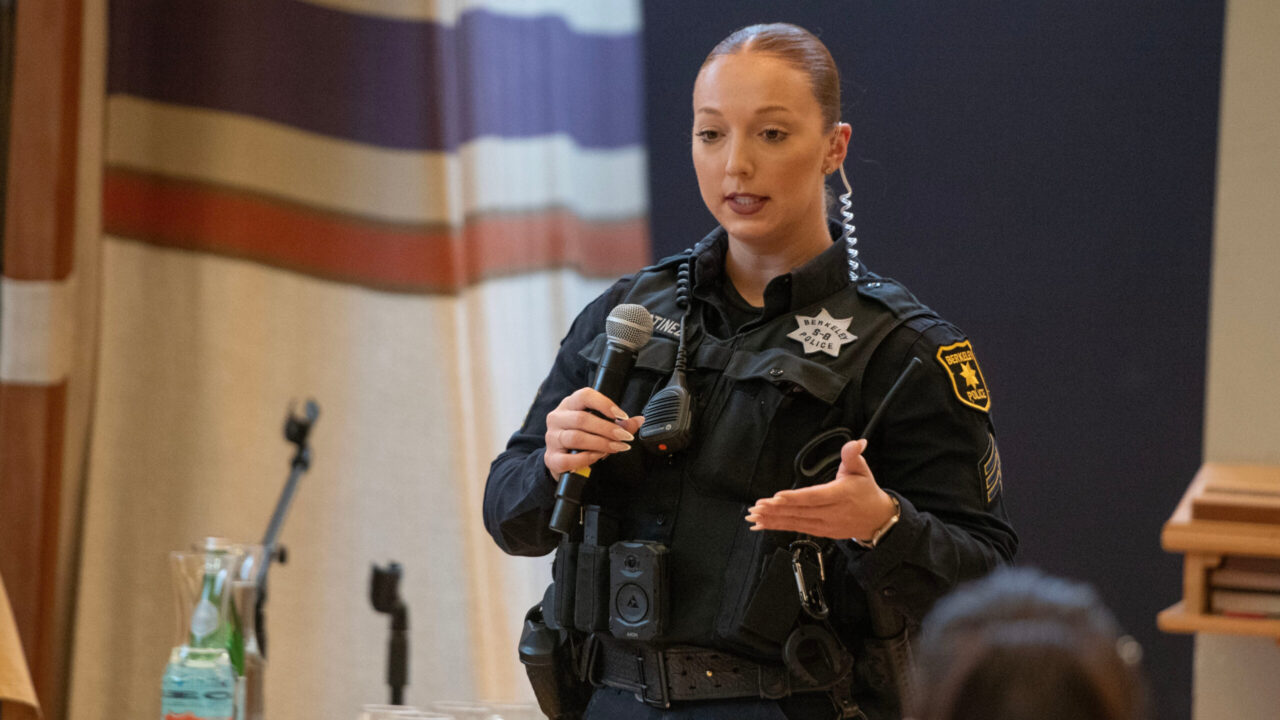
At a community safety briefing at Berkeley’s Congregation Netivot Shalom Wednesday night, one Jewish resident asked a question that was likely on the minds of many in the audience.
“Should we take down displays of support for Israel from our windows?” she asked. “Are we asking for trouble?”
“No,” Berkeley Police Sgt. Darrin Rafferty responded. “This is America, and you have your right to free speech just as everyone else does.”
The exchange came during one of two safety briefings this week in Berkeley and San Francisco, where law enforcement officers addressed concerns of the Jewish community after a series of antisemitic and anti-Israel attacks.
In early June, Manny’s Cafe in San Francisco’s Mission District was hit with threatening graffiti reading “Die Zio” and “Death to Israel is a promise.” A week later, a Jewish woman and her male friend were attacked in the Marina District by someone allegedly shouting “Free Palestine” and “F*** Jews.”
The San Francisco District Attorney’s Office is prosecuting the Marina case as a hate crime and has charged two men with assault and a hate crime enhancement.
DA Brooke Jenkins described how hate crimes are prosecuted in San Francisco County at a Monday evening webinar organized by the Jewish Community Relations Council Bay Area, the American Jewish Committee San Francisco and the S.F.-based Jewish Community Federation and Endowment Fund.
“What we are looking for is not only proof of that crime … we are also looking for the proof of the motive in order to charge that hate crime enhancement,” Jenkins said, describing hate crimes as “difficult to prove.”
San Francisco Police Capt. Amy Hurwitz emphasized the importance of reporting potential hate crimes to the police. “If you don’t report it, we won’t know about it, and none of this process is ever going to happen,” said Hurwitz, who serves as the SFPD’s Jewish community liaison.
Berkeley police officers and Alameda County DA Ursula Jones Dickson reiterated the same thing at Netivot Shalom.

“It does not matter how small it is, if it’s big, if you believe that it’s just a hate incident — we need all the information we can get,” Berkeley Police Sgt. Samantha Martinez said.
Earlier this year, a pro-Palestinian activist pleaded guilty to a series of politically motivated arson attacks in Oakland and Berkeley during summer 2024, including firebombing a police vehicle and attempting to light a government building on fire.
One way to prove motive in a hate crime case is hate speech, said Alameda County DA Dickson. Even though speech is protected by the First Amendment, a hateful comment toward a specific group may become relevant if the same individual later commits a crime targeting that group.
The Wednesday panel was organized by AJC and the Jewish Coalition of Berkeley, a grassroots advocacy group that formed shortly after Oct. 7, 2023, when anti-Israel activism began to seep into local schools and city council meetings. It now has over 400 members, according to Itamar Landau, one of its founding members.
During the Q&A portion of the event, a member of the Jewish Coalition of Berkeley asked about a July 3 vandalism incident, in which witnesses spotted around 30 people dressed in black and shouting slogans “critical of the Israeli Defense Forces,” according to a report in the Berkeley Scanner. People were also reportedly seen spray-painting graffiti and smashing the windows of the Berkeley Marine Corps Recruiting Center, one block from the UC Berkeley campus.
So far, four people have been arrested in connection with the incident, the Berkeley Scanner reported.
“That’s an ongoing investigation,” said Berkeley Police Lt. Matt McGee. “We know that’s of importance and interest to the community, but we want to find as many people responsible [as possible], so we can’t comment on that any further.”
These investigations and court cases take time. However, there is another option available for individuals or community organizations dealing with repeat offenders who may be acting unpleasantly, but not illegally.
“If somebody is coming to your place of worship and screaming hateful things, and they’re right outside the door, and that’s happening every Saturday, maybe we get a restraining order,” Dickson said. “And if that person comes back again, then maybe we can pick up a violation of a restraining order.”
Rafael Brinner, the Federation’s senior director of community security, attended both panels to promote a new virtual training program on situational awareness and de-escalation. The Federation started offering the training following the June 1 firebombing attack on Run for Their Lives activists in Boulder, Colorado, Brinner told J. in an email on Thursday, and will continue to do so every two weeks until the High Holidays. The next training will take place on July 30.
There are multiple ways to report antisemitic incidents and potential hate crimes. In San Francisco, if dealing with an emergency situation, call (415) 553-8090 to reach the 911 dispatcher directly. Non-emergency incidents can be reported to San Francisco Police at (415) 553-0123, and to Berkeley Police at (510) 981-5900.
Brinner also recommended submitting reports online to both the Federation through its incident reporting form and to the Anti-Defamation League, which evaluates them for inclusion in its annual audit of antisemitic incidents.