

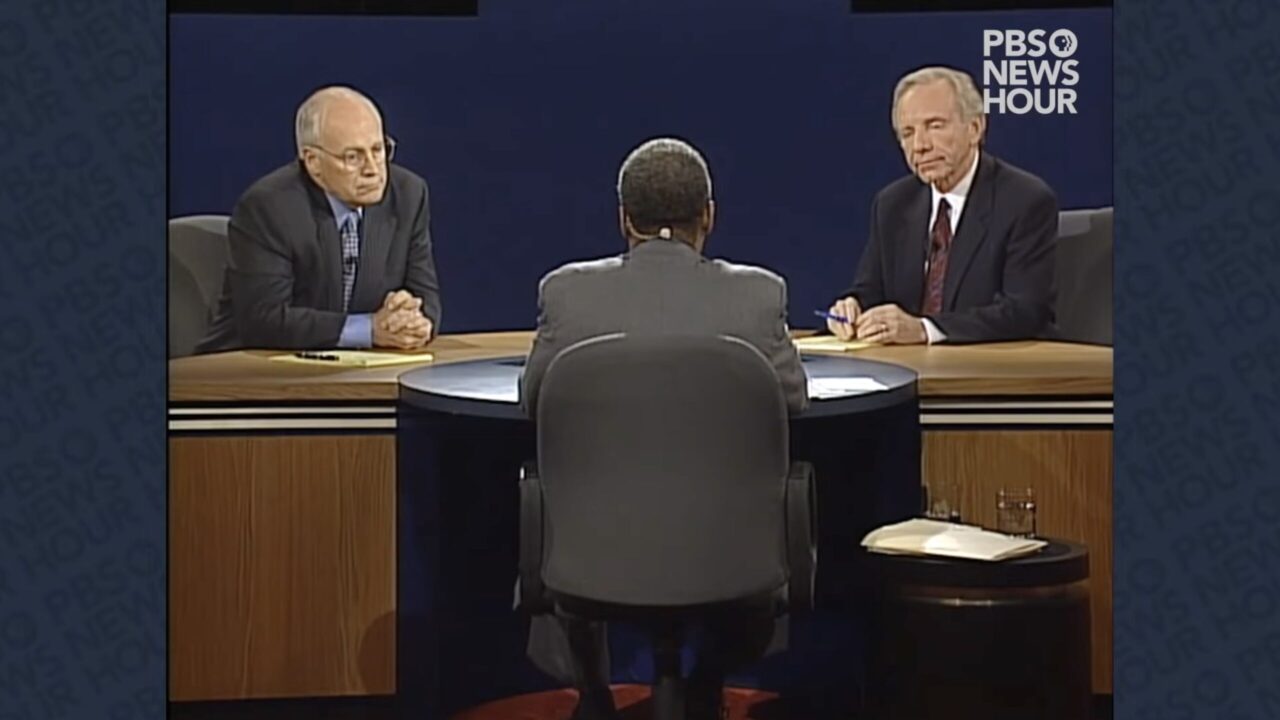
Twenty-five years ago this month, Jews across America kvelled at the news of then-presidential candidate Al Gore’s pick for his running mate. Joe Lieberman, a Democratic senator from Connecticut, became the first Jewish candidate on a major party presidential ticket.
The front page of this publication on Aug. 11, 2000, led with a headline conveying both intrigue and a hint of skepticism: “A Jewish vice president?”
The article that followed, written by our longtime reporter and columnist Alix Wall, noted that it wasn’t his Modern Orthodox identity that might sway Jewish Republicans into voting Democrat. It was Lieberman’s stand on political issues — aligned more with Gore’s opponent, George W. Bush, than with Gore himself — that could attract them. Lieberman’s rebuke of President Bill Clinton in 1998 was also considered a plus among Jewish Republicans.
“Widely respected by both parties, the Democratic vice presidential designee has been called ‘the conscience of the Senate’ for, among other things, his outspoken condemnation of President Clinton’s behavior in the Monica Lewinsky affair,” Wall wrote.

Our newspaper included a special section in that issue called “Campaign 2000: The First Jewish Candidate,” filling several pages with articles ranging from the reaction of Lieberman’s proud mother about her “mensch” son to the mezuzah and tzedakah boxes adorning his Senate office.
Lieberman himself called Gore’s decision an “act of chutzpah.” And in some ways, he was right. Back in 1984, then-San Francisco Mayor Dianne Feinstein was reportedly floated as a running mate for Democratic presidential candidate Walter Mondale, but “her Jewishness was considered a detriment,” according to a story we ran in August 2000.
“It’s taken a while, but America has finally come of age,” Abraham Foxman, national director of the Anti-Defamation League, said in 2000 of Lieberman’s candidacy. “I think people now recognize that these are public servants who happen to be Jews, not Jews who happen to be public servants.”
Some Jews feared an antisemitic backlash, while others dismissed those fears as needless hand-wringing.
“I realized that America is ready. And if it isn’t, it should be,” Tracy Salkowitz, regional executive director of the American Jewish Congress, told us after she came to terms with her own concerns over Lieberman’s selection.
Some Bay Area rabbis noted that the fears of possible antisemitism reflected an unsettling concern buried within the Jewish community.
“Perhaps we don’t feel as secure here as we thought we did.… Perhaps the fear of latent anti-semitism lies much closer to the surface of our lives than we have imagined,” said Rabbi Alan Lew of Congregation Beth Sholom in San Francisco.
Yitzhak Santis, Peninsula director for the Jewish Community Relations Council, disagreed.
“We live in a whole new world. This country is not what it was 40 years ago,” Santis said. “Or even 20 years ago.”

Many Jews rushed to donate to the campaign.
We reported on Nov. 3, 2000 — four days before the election — that Lieberman had “turned into a kosher cash cow” for Democrats.
“At a Silicon Valley fund-raiser early last month, the take was $3.2 million, a record for a vice presidential candidate; the audience was a mix of high-tech executives and Jewish leaders,” we reported.
Despite the robust campaign dollars, Bush and his vice presidential candidate, Dick Cheney, eked out a win. A tumultuous investigation into hanging chads on Florida ballots and a historic controversy over a recount were resolved in Bush’s favor by a single vote in the U.S. Supreme Court more than a month after the election.
Jews, as usual, voted overwhelmingly Democrat, although Jewish turnout for the Gore-Lieberman ticket wasn’t remarkably different from previous elections. Exit polls showed that Gore-Lieberman captured 79 percent of the Jewish vote: 1 percentage point more than Clinton received in 1996, and 1 percentage point less than Clinton received in 1992.
This wouldn’t be the end of Lieberman’s White House aspirations. In January 2003, he announced he was seeking the Democratic nomination for president.
That same month, we wrote about “An Amazing Adventure,” a memoir written by Lieberman and his wife, Hadassah, that detailed how they maneuvered running a vice presidential campaign as an Orthodox family.
“Kosher food was brought to their hotels throughout the campaign by Lubavitch rabbis who knew their locales even though they were supposed to be a secret. And a Sukkah booth was crafted next to the Secret Service station outside the Liebermans’ Washington home,” the article said.
Lieberman dropped out of the presidential race in February 2004 when Sen. John Kerry of Massachusetts swept the Democratic primaries. Two years later, Lieberman ran for Senate again and won — as an independent in the general election after losing the Democratic primary.
Lieberman died in March 2024 at age 82. His legacy among Democrats was mixed in the end. Even so, his vice presidential candidacy at the turn of the century was not only historic, but also inspirational for American Jews. Ira Forman, executive director of the National Jewish Democratic Council, said after Lieberman ended his run for president in 2004: “He has blazed a path for future candidates who might one day be president of the United States.”