
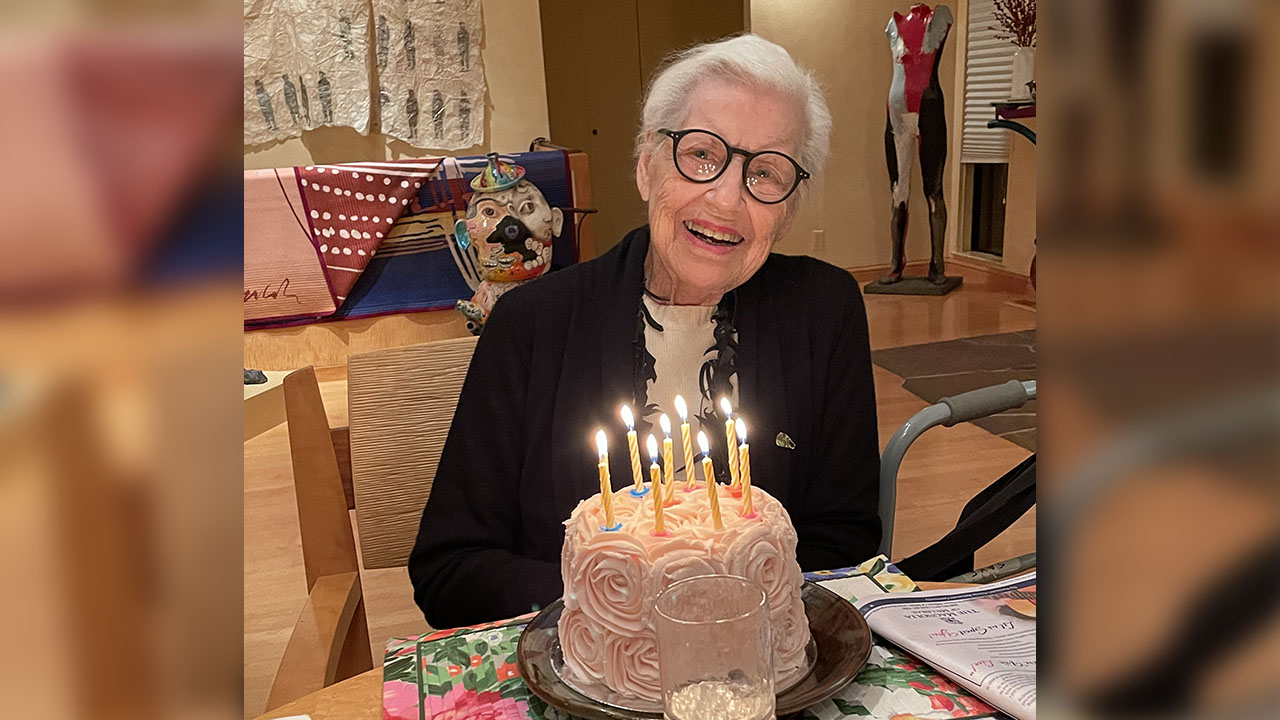
My mother-in-law is almost 100, but she doesn’t define herself as old.
Dorothy Saxe continues to serve on the boards of the Contemporary Jewish Museum in San Francisco and the Pilchuck Glass School in the Seattle area. She regularly sees friends in the Bay Area. She was still driving well into her 90s.
The most common adjective that everyone uses to describe her is “amazing.”
I recently spoke with Dorothy to get her insights into healthy aging. Her advice is to eat healthy, exercise, get enough sleep and maintain social relationships.
“I’ve been lucky and blessed. I live gratitude,” she said.
In brief, she feels positive about aging.
Dorothy typifies what Yale professor Becca Levy describes in her 2023 book, “Breaking the Age Code: How Your Beliefs About Aging Determine How Long and Well You Live.”
Levy’s research found that people with positive perceptions of aging live on average 7.5 years longer than those who feel otherwise. She found that this advantage remained valid after controlling for age, gender, socio-economic status, loneliness and functional health.
In her book, Levy describes her pathway to a career in aging research. She recognized her own prejudices about aging at the age of 21 when she worked in the geriatric ward of a psychiatric hospital. She assumed that mental illness was rampant among older persons and could not be treated successfully.
Instead she wrote, “Contrary to my initial assumptions, mental illness is actually much less common in older than in younger adults, and that most older persons with mental illness can be successfully treated.” Ageism is the most widespread and socially accepted prejudice today, according to the World Health Organization, and one out of every two people in the world hold anti-aging attitudes. Levy has dedicated her career to investigating how the mind-body connection influences aging and how to combat negative aging stereotypes.
Levy explains that having positive self-perceptions of aging is not the same as whether someone is an optimist or pessimist. Our perceptions are strongly influenced by the culture in which we live. For example, Japanese culture venerates old age, so it should not come as a surprise that Japanese men and women have among the longest life expectancies in the world. Levy writes, “In Japan, old age is treated as a time to enjoy rather than to fear.”
Here are examples from Levy’s book about how positive aging beliefs translate to better health.
In one of her experiments, participants who were primed with positive age beliefs immediately showed faster walking speeds and better balance, compared with those who were given negative stereotypes of aging.
A blood marker for inflammation called C-reactive protein (CRP) rises with cumulative stress. Positive age beliefs predicted lower CRP levels, leading to longer survival.
The APOE gene has variants that influence our susceptibility to Alzheimer’s. The riskiest variant is APOE4, which 15% of the population is born with. Those who carry this variant but had positive age beliefs were 50% less likely to develop Alzheimer’s than those with negative beliefs. In other words, their risk of developing dementia was as low as those born without the risky gene.
Levy describes 14 negative stereotypes about aging. I will highlight two of them.
One false stereotype is that older people are bad drivers. According to Consumer Reports, the number of crashes involving older drivers is low. Additionally, older drivers are more likely to wear seatbelts and follow speed limits and less likely to engage in distracted driving.
There is also a false stereotype that all types of cognition inevitably decline in old age. Episodic memory — the kind of recall of a specific experience at a particular time and place — may decline, but procedural memory (like riding a bike or playing the violin) stays the same. Some forms of memory even improve, such as semantic memory, or the recall of general knowledge. Older people often excel in pattern recognition and in taking into account multiple perspectives.
Levy’s finding of greater longevity with positive aging beliefs has been replicated in 10 countries including Australia, China and Germany.
How does one develop a positive mindset about aging? The first step is to become aware of your own age beliefs and to reject ageist stereotypes. Here are some suggestions from the American Heart Association on how people can improve their attitude about aging: Maintain a sense of purpose such as caring for grandchildren or volunteering. Recognize that practicing healthy behaviors is important at any age. Stay socially active. Try something new. It’s never too late to explore new interests.
My mother-in-law, whose 100th birthday is just around the corner on Feb. 10, exemplifies Levy’s research findings that possessing favorable self-perceptions of aging leads to increased longevity. With a positive attitude, we all have the potential to be amazing.