

It’s official. Israelis aren’t white — at least in California.
On Oct. 6, Gov. Gavin Newsom signed AB 91 into law, creating a new racial or ethnic category to be used when California agencies collect demographic data.
Middle East and North African, or MENA, is a new demographic designation that explicitly includes those with “ancestry or ethnic origin” from Israel, as well as other countries in the Middle East. It is distinct from the “white” category, which until recently encompassed Middle Eastern ethnicities.
Of course, nothing about race is that simple. Nor, for Jews, is the issue of identity.
“The thing about these categories is the definitions of them matter, in a sense, far less than what the uses of them are meant to be,” said Lila Corwin Berman, a professor of Jewish history at New York University.
According to the text of the bill, MENA includes the “Middle Eastern group, including, but not limited to, Afghan, Bahraini, Emirati, Iranian, Iraqi, Israeli, Jordanian, Kuwaiti, Lebanese, Omani, Palestinian, Qatari, Saudi Arabian, Syrian, Turkish and Yemeni.”
North African countries are also included, as is what the law calls a “transnational” group of ethnicities like Kurdish and Armenian that span various countries.
In theory, that would mean that Israeli Jews, or American Jews with Israeli heritage, could mark “MENA,” while Jews with heritage from Poland could not, creating a white dividing line through American Jewish identity.
AB 91 is in line with a policy change at the U.S. Census Bureau that was proposed in 2023 and approved in March of this year. It’s the culmination of a long push by Arab, Armenian and Somali organizations to create a new category that is distinct from white. The bill was introduced by Assemblymember John Harabedian, a Democrat from Pasadena who is Armenian. He said he did so in an effort to ensure proper representation in demographic data.
“Many people from the Middle East and North Africa don’t see their lived experiences reflected when they’re grouped as ‘white,’” he said in a statement provided to J. “This bill gives them the option to identify as they see fit, so state data and services can respond to their unique cultural and community needs. One of the many things that unites MENA communities is a history and identity rooted in a diverse region that has too often been overlooked in our data and policymaking.”
That’s an important consideration, said Paula Braveman, a professor at UCSF and founding director of the Center for Health Equity. She has studied how socioeconomic and ethnic disparities affect health for over 25 years.
She said there’s solid scientific evidence showing that discrimination can impact public health. (It’s been linked to risk factors for obesity, high blood pressure and substance use, as well as psychological stress and mental health issues.) While creating a new ethnic category doesn’t change whether a person experiences discrimination, it does allow public agencies to track it.
“If you don’t have a separate category, you can’t say what’s happening with it,” she said. “That’s the problem.”
Once it’s clear what challenges a particular group is experiencing, policy and programming can be formulated to try to address them. Changing the way data is collected takes work, as forms have to be changed and personnel trained, she said, but it’s worth it.
“There’s a cost, but I think in this case the research showing a number of serious examples of discrimination-related health damages among people of Middle Eastern origin was striking enough and compelling enough,” she said.
Still, the new law opens up particular questions for Jews, especially non-Israeli Jews.
Berman, whose book “Who Is American? Belonging and the Question of Jewish Citizenship” will be released in the spring from Princeton Press, said identity and politics always play a part in how Jews are defined.
It’s not the first time questions about Jews and whiteness have come up.
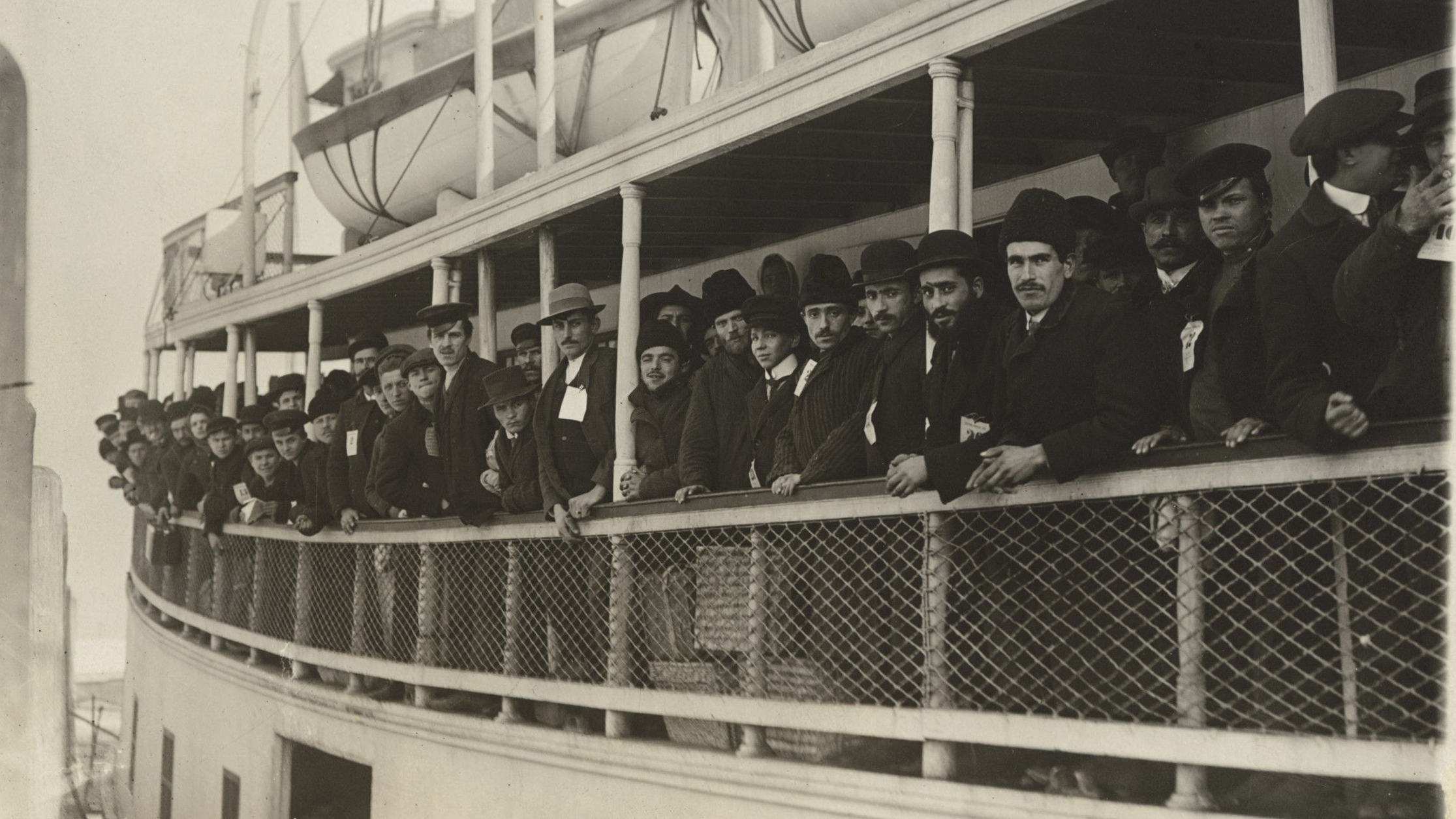
In the early 20th century, white and Black people had a pathway to citizenship in the United States, while Asians did not. But that left a large gray area for Jews, Arabs, Armenians, Persians and others.
To increase the odds of getting citizenship, “a lot of Jewish organizations that came before Congress and provided testimony in the early 20th century were adamant that Jews simply be counted as the kind of nationality that they came from,” Berman explained. So a French Jew, for example, could be considered French, and thus white.
Back then, too, the arguments around citizenship for Jews were tangled up with the status of Arabs. If Jews could be citizens, did that mean other people from the Middle East could, too?
“One judge in one of these cases says, ‘Yes, of course, Jews can be citizens, but they get that because they’re European,’” Berman said. “And somebody says, ‘So, if a Jew were from Jerusalem, the cradle of Christianity, should they get citizenship?’ And he said, ‘Absolutely not.’”
Among jurists, legislators and the general public, views were divided, she said.
“They say it must be a real loophole that allowed Jews to gain citizenship, and maybe they shouldn’t,” Berman said. “And so Jewish lawyers start to get involved representing some of these Arab petitioners because they get scared, and they say, ‘We better make sure that those Arab petitioners get citizenship, because if they don’t, it’s going to reflect poorly on our citizenship story.”
There’s an argument to be made that Jews of all stripes fit into the “transnational” category along with Armenians and Kurds, according to Sarah Levin, executive director of JIMENA (Jews Indigenous to the Middle East and North Africa). She understands the need for underrepresented groups to be counted for demographic data, but said the law is “a positive step with a serious gap.”
“The bill acknowledges ‘transnational’ MENA groups such as Kurds, Armenians, Assyrians, Chaldeans and Circassians, all Indigenous peoples with diasporic communities spanning multiple modern states,” she told J. “This is precisely the situation of the Jewish people. We are indigenous to the Middle East and North Africa, dispersed across borders due to persecution and expulsion, and now maintaining diaspora communities worldwide.”
She said also she worried the law could create a split between “white” Ashkenazi Jews and “nonwhite” MENA Jews. It also lumps in, say, Egyptian Jews with all other Egyptians, without recognizing that they have different backgrounds and experiences.
“The outcome risks reinforcing the invisibility of Mizrahi and Sephardic Jews in broader Middle Eastern and North African initiatives and narratives,” she said.
Whether Jewish people tick “MENA” or “white” on a form may not make much practical difference in their everyday lives. But Berman said the whole issue of how race, nationality and ethnicity intersect is one that never goes away, especially for Jews.
“There’s nothing new about these debates,” she said, “but the answers are always shifting to respond to different moments and their political moments and their identity moments.”