

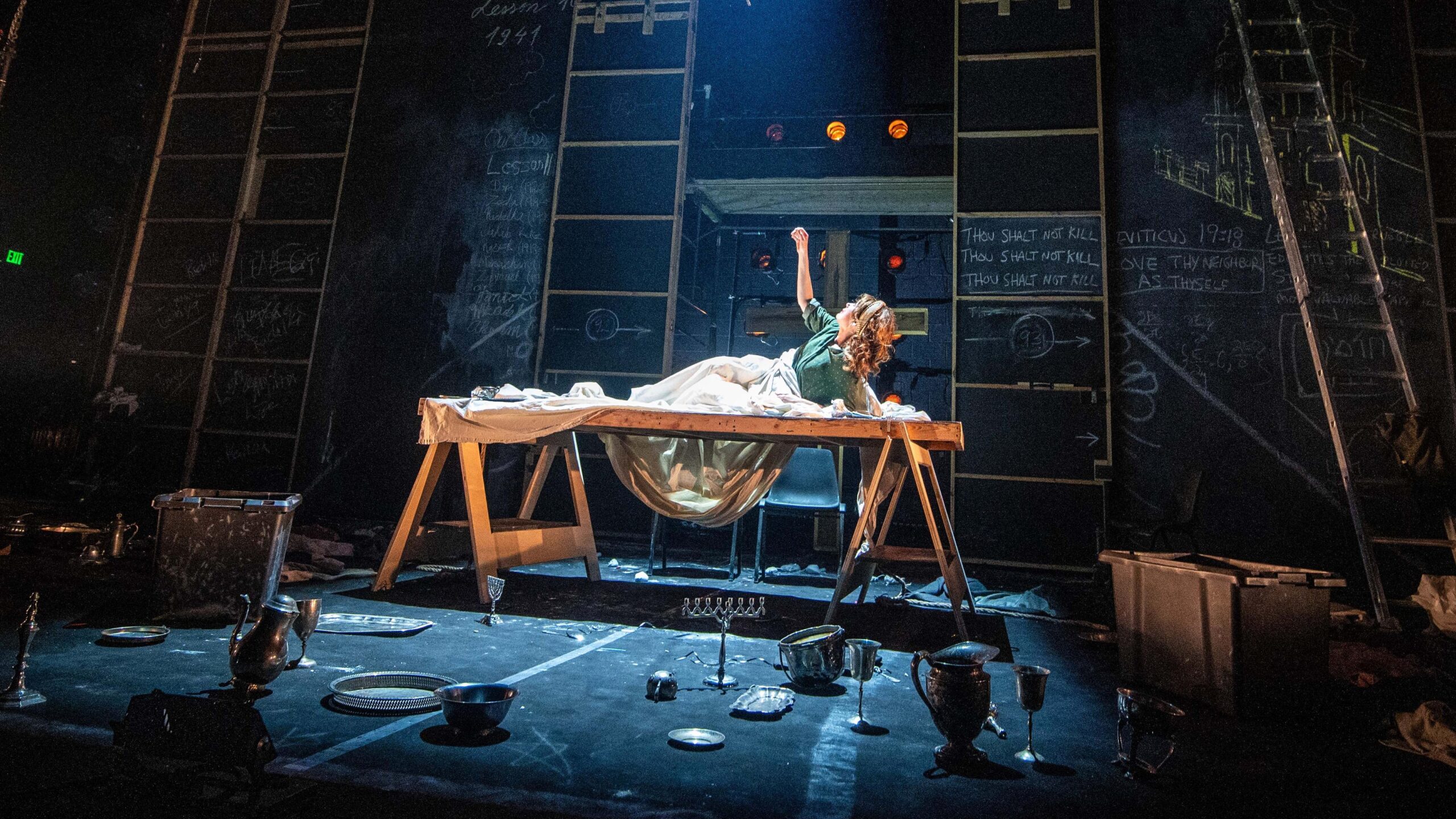
In July 1941, in a small village in Nazi-occupied Poland, hundreds of Jews were burned to death in a barn — not by the Nazis, but by their own non-Jewish neighbors.
The Jedwabne pogrom, whose true history was revealed only in 2000 with the publication of Jan T. Gross’ book “Neighbors,” is the focus of a play coming to San Francisco this month.
“Our Class” follows the lives of 10 Jedwabne residents — five Jews and five Catholics — from 1925 through the end of the 20th century. The classmates begin as schoolyard friends, then grow into adults who love, betray, murder and confront the repercussions of their actions over the years. The play is based on the experiences of real perpetrators and victims of the massacre.
Written in 2008 by Polish playwright Tadeusz Słobodzianek, “Our Class” has been staged around the world. It made its Off-Broadway debut at the Brooklyn Academy of Music in January 2024 in a production staged by Arlekin!, a Massachusetts-based troupe composed largely of immigrant artists from the former Soviet Union. It received numerous accolades, including “best theater of 2024” from the Wall Street Journal, and four Lucille Lortel Awards for outstanding revival, ensemble, director and scenic design.
On March 27, Arlekin! brings that production to San Francisco’s Z Space for a week-long run.
The company’s director, Ukrainian-born Igor Golyak, told J. that while many plays have explored the Holocaust, “Our Class” stands out for showing how “regular” people could turn on their neighbors.
“The way that I’ve experienced coming to a Holocaust play is you kind of button yourself up emotionally, you know what you’re going to get hit with,” he said. “I wanted to make this different, because it’s not about the Nazis doing awful things, it’s people just like us, you and me. In what situation would I do this to you? Or would you do this to me?”

As a Ukrainian Jew, the play’s subject “hits close to home,” he said, referring to both the long history of antisemitic violence in Ukraine and the ongoing Ukraine-Russia war.
Golyak said the cast first gathered in August 2023 to read the script and began discussing the implications of antisemitism and neighbor turning against neighbor. Six weeks later, the Hamas attacks of Oct. 7 took place.
“Jews have been persecuted for all of their existence,” he said. “We could say yes, we’ve learned our lessons. But obviously we haven’t. I don’t believe in teaching history lessons. The only thing I believe in is asking the questions and asking people to question themselves.”
The story of the Jedwabne pogrom has inspired several films, including the 2005 documentary “The Legacy of Jedwabne,” which contains testimony from Jewish and non-Jewish survivors of the pogrom, as well as from church authorities who claim that the entire operation was carried out by Germans rather than Polish citizens.
The full extent of the murders might never be known. In “Neighbors,” Polish historian Gross wrote that “one day, in July 1941, half of the population of a small East European town murdered the other half — some 1,600 men, women and children.” Later investigations claimed no more than 350 people could have fit in the barn.
But the numbers aren’t the point of “Our Class.” Eight of the 10 characters are based on real people, Golyak said. The barn-burning happens before the end of the first act, so most of the play is about how the characters deal with the tragedy for the rest of their lives.
The main protagonist, Rachelka, a Jewish woman, converts to Catholicism to marry her Polish lover, a choice that saves her life. How does she justify that decision to herself in the ensuing decades? Renowned Russian-language actress Chulpan Khamatova portrays Rachelka. As a member of the Tatar ethnic minority in the former Soviet Union, Khamatova said the Jewish girl’s story resonates with her.
“When I grew up in the Soviet Union, I didn’t want to tell people my name was Chulpan,” she said. “I always said my name is Masha, or Olga. Otherwise I’d get a lot of hate speech.”
Khamatova recalls watching the real Rachelka in a documentary. It showed her in her 80s spending time in a dark room watching TV. “She didn’t want to go for walks, or read letters, she just wanted to be in that unreal world of the TV screen,” Khamatova said. “She lost so much during her life, and was broken in such a brutal way.”
In one scene in the play, taken from real life, Rachelka is asked by a judge after World War II to describe what her Polish neighbors did to her.
“She says, ‘Nothing,’” Khamatova said. “That means she betrayed all her relatives who burned in that barn. Yet I can’t say she’s guilty or not guilty. I want to be very careful about judging. It’s so easy to lose your humanity, and so lose yourself. If audiences can get that from this play, great.”
Golyak said some descendants of Jewish survivors of the massacre have come to see the play. One was a woman whose grandmother was saved by the real-life Polish woman portrayed on stage by one of the actors.
On the other hand, some of the perpetrators, whose stories are depicted in “Our Class,” have denied responsibility, Golyak said.
“These are real people, you can find them on YouTube in interviews saying this never happened,” he said. “It’s very scary. Again, it’s scary not because they’re them. It’s scary because they’re people just like us. And that is the questioning that I want the audience to leave with.”
IF YOU’RE GOING