

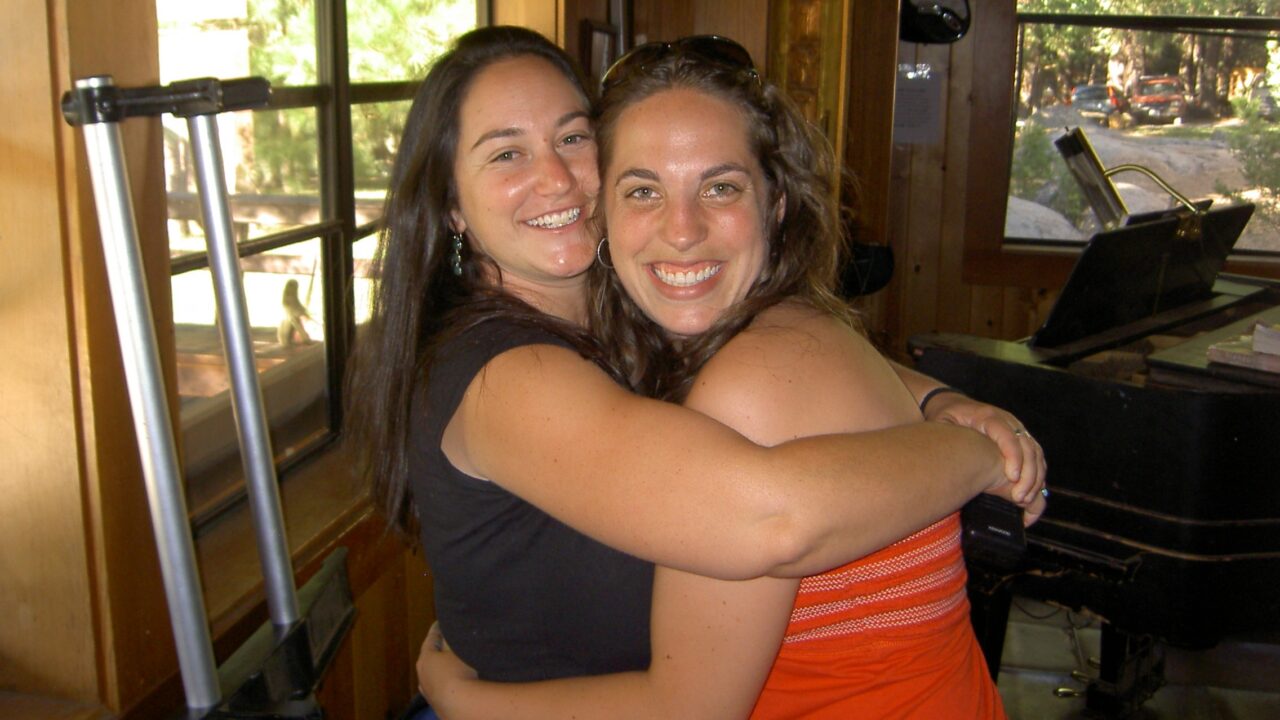
It was the summer of ’93 when Ryley Katz and Jamie Simon first met.
Katz was 9 years old and had just arrived at Camp Tawonga by bus from Arizona, alone and unsure what her summer would have in store.
“I remember that feeling of being so nervous and not knowing what camp was going to be like, and Jamie was one of the first people I met,” Katz recalled.
Simon was a year older and already had a few summers under her belt at the camp near Yosemite National Park. The girls were in “sister bunks,” an arrangement where separate cabins are paired together for activities, meals and social events to foster community. Katz and Simon immediately clicked, sparking what would become an enduring bond. The next year they became bunkmates.
Fast forward 33 years, and the two women have shared decades at Tawonga together as campers, counselors, leaders and, now, CEOs.
Katz began her tenure as interim CEO on March 1, after serving as senior director of programs and innovation since 2022. She previously served Tawonga for nearly a decade, before she left for a time to focus on raising her three daughters.

Simon served on staff at Tawonga for 17 years, including six years as CEO from 2017 to 2023. She left to join Foundation for Jewish Camp, a national organization where she became chief program and strategy officer and then interim CEO. In 2025, she became the first woman to step into the role of CEO in the group’s 27-year history.
While neither woman could foresee one day trading Tawonga’s cabins for corner offices, the two lifelong friends say their professional successes are testaments to the power of Jewish camp.
“When you have great mentors like our counselors, who really believed in us so that we believed in ourselves, you’re able to build a foundation for future leadership through that experience,” Simon said.
The two lifelong friends spoke to J. recently about camp, leadership and each other. This interview has been edited for length and clarity.
What was your first impression of each other?

Simon: What I remember about her from that summer is she was then exactly who she still is today. She was kind to everybody, and she was a community builder. The Ryley who just treated everyone with such kindness and care that summer is still the Ryley I know today.
Katz: Jamie was one of the first people that I met, and she is just a bright star. She’s welcoming, she’s warm, she’s curious. She just brought me in and made me feel so at home in a place where I wasn’t sure how it was going to feel. It became home, in large part, because Jamie made me feel that way from the very beginning.
If your younger selves saw you now, what would they think?
Katz: Jamie and I have joked that our 10 year old selves would be so proud of where we’ve come. I think that there has always been a layer of leadership to who we’ve been, and we always knew that we were going to use our voices to do good in our community. It’s been a long path together alongside one another, working together and supporting one another. I think our young selves would be proud, and I think our current selves are very proud of where we’ve gotten to and being able to continue to support Tawonga … after it’s done so much to help us grow as well.
Do you feel pressure as an alum to “get it right”?

Simon: I wouldn’t say I felt pressure. But when I took over in 2017 as CEO I felt a lot of responsibility to the leaders who came before me. There were so many amazing people that had stewarded this place for so long. I felt a responsibility to do it justice, to take everything I had learned, knowing I was going to just be passing through and to have my moment to make a mark. Just a responsibility to give the care and generosity of spirit and love to this place and this community, this land, that it so deeply deserves.
Katz: Yes. I think that there is this continuity that exists in Tawonga that enables us to continue tradition while we meet the moment and help Tawonga to be what it needs to be for our community right now, while still staying focused on the traditions and the long legacy that has come before us.
What is something about camp that feels different once you’ve led it as opposed to being the camper experiencing it?
Simon: One thing I thought more about as a leader than when I was a camper or summer staff member was intentionality. There are the Tawonga values of building self-esteem, creating community and raising people who care about the world and want to participate in tikkun olam and helping kids have a positive Jewish identity. When you’re a kid, it feels very natural, just like, ‘Oh yeah, we’re having song sessions with Jewish songs’ or ‘I’m playing gaga and we’re talking about a Jewish value before we play.’ But when you’re a director, executive director or a CEO, you’re actually thinking much more about how it’s intentional and how to intentionally infuse the values that make the camp so special into everyday life. And that was a thing I hadn’t considered before I rose through the ranks of the organization.
Katz: We want kids to come to camp and just get to feel like kids. And for the Tawonga mission to just come to life in the ways that they interact with their bunkmates and the activities that they do throughout the day. But as staff, creating the environment with the intentionality that enables them to feel that way is truly a gift. It has been special as I’ve grown through Tawonga to be a part of that intentionality, so that those traditions feel so natural for the kids — and that for staff, it feels empowering to continue to carry them out.
What do you admire about the other’s leadership style?
Simon: Ryley is a relational leader, and I’m sure she learned those skills at camp. I admire Ryley’s ability to lead both with heart and rigor. She holds Tawonga’s mission at the center. She has this unique balance of being a heart-centered leader but is not going to lose sight of mission strategies, what’s best for the greater organization and the greater good for the children.
Katz: I have admired Jamie since we were kids. Jamie has always approached things from a values-driven perspective. She is so skilled at bringing warmth and empathy to what she does while holding people accountable and really being a strategic, big picture thinker, while never leaving anybody out. She is incredibly skilled at bringing people together and building community. When we were kids, leadership looked different than it does today, but she has never changed from who she is, and it’s just something I’ve always loved and admired about her.
What are memories from your camp days that still make you laugh?
Simon: We both had so many firsts at camp. First kiss, first relationships, making my first best friends, including Ryley, my first dance. I still remember Ryley and I giggling in the bathroom about who we danced with, and, you know, who we wanted to kiss and also my Jewish identity and our Jewish identity. I remember going to Shabbat with Ryley and getting dressed up together, and then dancing together. And at Tawonga, when you do Shabbat, you co-lead the service as kids. So we would always create the funniest skits or the funniest songs. Ryley would always write really creative songs and poems. Like we’d be assigned to Shema, for example. And Ryley would write an amazing poem about listening that we would then read as a bunk.
Katz: I just remember feeling so much love and joy together. I think that my memories are centered around growing up and lots of giggles and lots of just all the things that come with growth and healthy independence at camp.
We had incredible counselors who really empowered us and helped us feel great about who we were in that moment and who we were becoming. And there are people that I still admire and look up to. And it’s been a special thing to know that there … are young kids who look up to us and so on. It’s the continuing cycle of camp.
Who broke more camp rules as a kid?
Simon: That’s easy! Me, for sure. I like some good trouble. Ryley is a rule follower.
Katz: I’ve never broken a rule!
Who would win a current day game of gaga ball?
Katz: Well, Tawonga is really rooted in the cooperative community. So it’s less about winning and more about working together to get to a common good. And so I think that Jamie and I would probably just be excellent teammates more than competing against each other.
Simon: OK, you’re nicer than me. I was going to say that Tawonga believes in cooperation and, you know, it’s a ‘Tawonga tie’ at the end of the game. But Ryley and I are also secretly both really competitive. So I think we would want to be on the same team, beating the other team.
What does it say about the power of camp that two bunkmates both felt called to lead it?
Simon: Our story reflects the multiplier effect of Jewish camp. When you invest in young people and communities of belonging and create safe spaces for them to thrive, you’re investing in the future of leadership and what Jewish community could be.
In my seat at FJC, I’ve seen 300-plus camps with incredible leaders and they all have a story. And a lot of those stories come from growing up at camp and learning how to take care of the community and each other, so I think it’s bigger than us. Yeah, we had shared cabins and a shared commitment to each other, but our journeys just highlight how Jewish camp cultivates both friendship and a durable leadership pipeline.
Katz: What Jamie said is so true. I think our story is very special, but when I look around the ecosystem of Tawonga and I look around the Jewish community in general, this is exactly what Tawonga is trying to do. To build leaders and connections and the story of endurance and growing young people into their best selves. We just happen to be two people who grew up together at this place that we both love so deeply and are in unique positions to be able to take a leadership role there. It really is a testament to Jewish camp overall.