

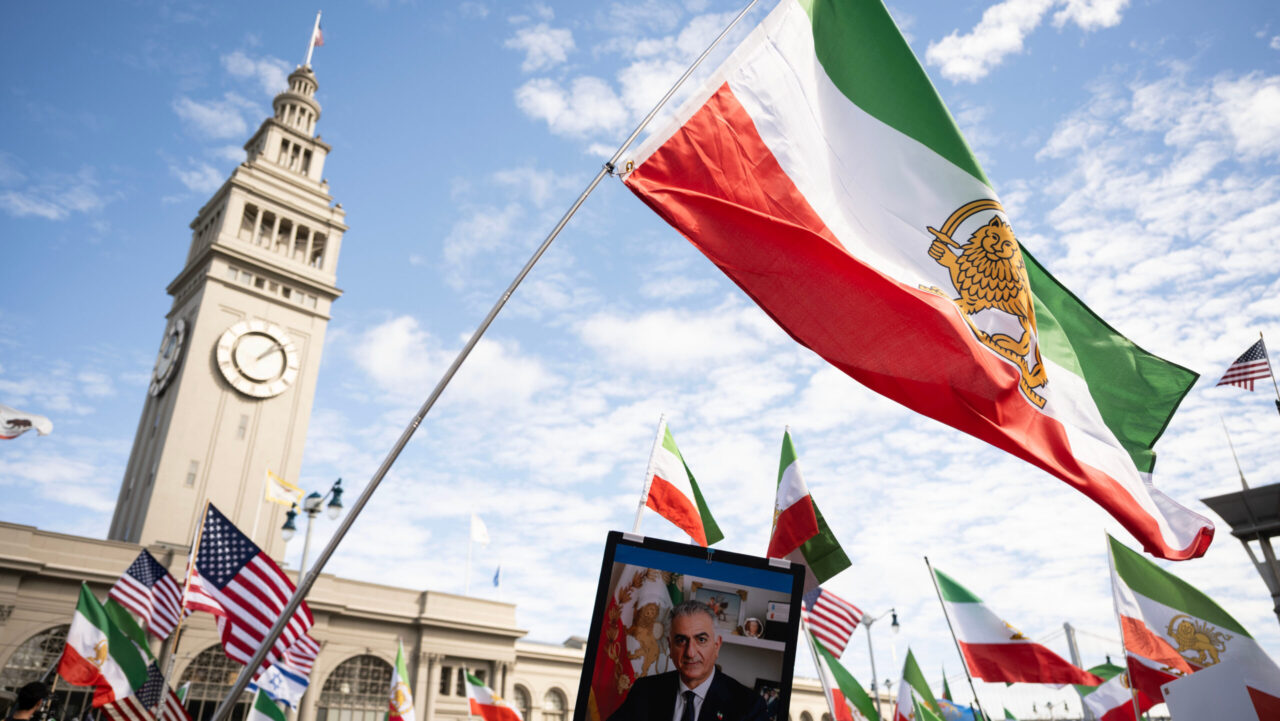
A majority of Americans, according to recent polls, oppose the U.S.-Israel war with Iran. But at least one group of Iranian Americans is firmly behind it.
The National Union for Democracy in Iran (NUFDI), a Washington, D.C.-based nonprofit, opposes the Islamic Republic of Iran and advocates for free and fair elections, a secular democracy and the protection of human rights.
“The Iranian people have been fighting this regime for five decades. Our brave brothers and sisters in the U.S. military and the IDF are bleeding beside us, and we are immensely grateful for their sacrifice,” said Khosro Isfahani, who is NUFDI’s research director and has been a journalist and political activist both inside and outside his native Iran.
Isfahani spoke Monday night during an online event organized by JIMENA: Jews Indigenous to the Middle East and North Africa, the Bay Area–based nonprofit that advocates for Jews from Arab and Muslim countries.
His message was unequivocal: The Iranian population doesn’t support the Islamic Republic, welcomes the intervention of Israel and the United States, and is fighting “with everything we have” to pave the way for the return of exiled crown prince Reza Pahlavi, the son of Mohammad Reza Pahlavi, who served as the shah from 1941 to 1979.
“The day the [missile] strikes began, women removed their hijabs and danced in the streets,” he said of Feb. 28, the first day of the current war.
Isfahani was born into opposition activism. His father was an activist jailed for four years after the 1979 Islamic Revolution, and Isfahani himself was taken by his father to his first anti-regime protest at the age of 9. Isfahani left Iran in 2021 for a reporting job at BBC Monitoring before taking the lead role in the Atlantic Council’s open-source research of human rights and international law violations linked to the Iranian regime.
The Iranian population has been “at war with the Islamic Republic since its inception,” he said.
But opposition has reached a new level since the 12-day war last June with Israel and the U.S. and since the grassroots uprising that began in late December, he said. “Millions of people took to the streets” to protest the regime, he said, and then the government massacred “tens and tens of thousands” of them.
“I have worked on war crimes. I thought I had seen every kind of atrocity,” he said. “But what we saw in January went beyond that. I have seen footage of infants hit by bullets. I have seen faces demolished by shotgun pellets. I have seen children dragging their parents away after they were shot dead.”
Minorities have been particularly targeted, he said, including the country’s 9,000 to 10,000 Jews. In the aftermath of the June war, he said, dozens of Jews were arrested on trumped-up charges. One was an Iranian American visiting Iran, who was arrested for traveling to Israel 17 years ago for his son’s bar mitzvah. Another was a Jewish man arrested for taking part in a WhatsApp chat that involved Hebrew. It turned out to be a Torah discussion group, Isfahani said.

Asked whether Pahlavi is seeking to restore his father’s monarchy, as is claimed in some media outlets, Isfahani said such charges are untrue. In fact, he said, Reza Pahlavi is the only figure with the moral authority to rally the Iranian people.
“We see him as the leader of the opposition,” Isfahani said. “He’s not seeking a title. He’s not seeking a crown. He sees himself as a bridge to the future. He has offered himself as a transitional leader that is going to enable Iranians to depart from the Islamic Republic and arrive at that secular democratic future.”
Isfahani referred the audience to recent interviews with Pahlavi, including one for the March 1 episode of “60 Minutes” after Supreme Leader of Iran Ali Khamenei’s assassination the previous day. “He has repeatedly said he wants to deliver us to the ballot box where we can determine our future with our vote. Then his mission will be over,” Isfahani said.
Sarah Levin, JIMENA’s executive director, concurs. “Within the Iranian Jewish community, and from what I hear in the broader Iranian diaspora as well, there is a wide consensus that Reza Pahlavi is the only credible candidate to guide the country through a transitional period toward a more democratic future,” she told J. in an email.
While urging the U.S. and Israel to continue their military pressure on Iran, Isfahani emphasized that no matter what those two nations decide to do, the Iranian opposition has reached a point of no return.
“We are not asking for America or Israel to commit boots on the ground. We don’t need that,” he said.
A “brighter future is finally possible for Iran,” he said. “We don’t want our country to be bombed, [but] there is no other way to end this Islamic fascist system.”