

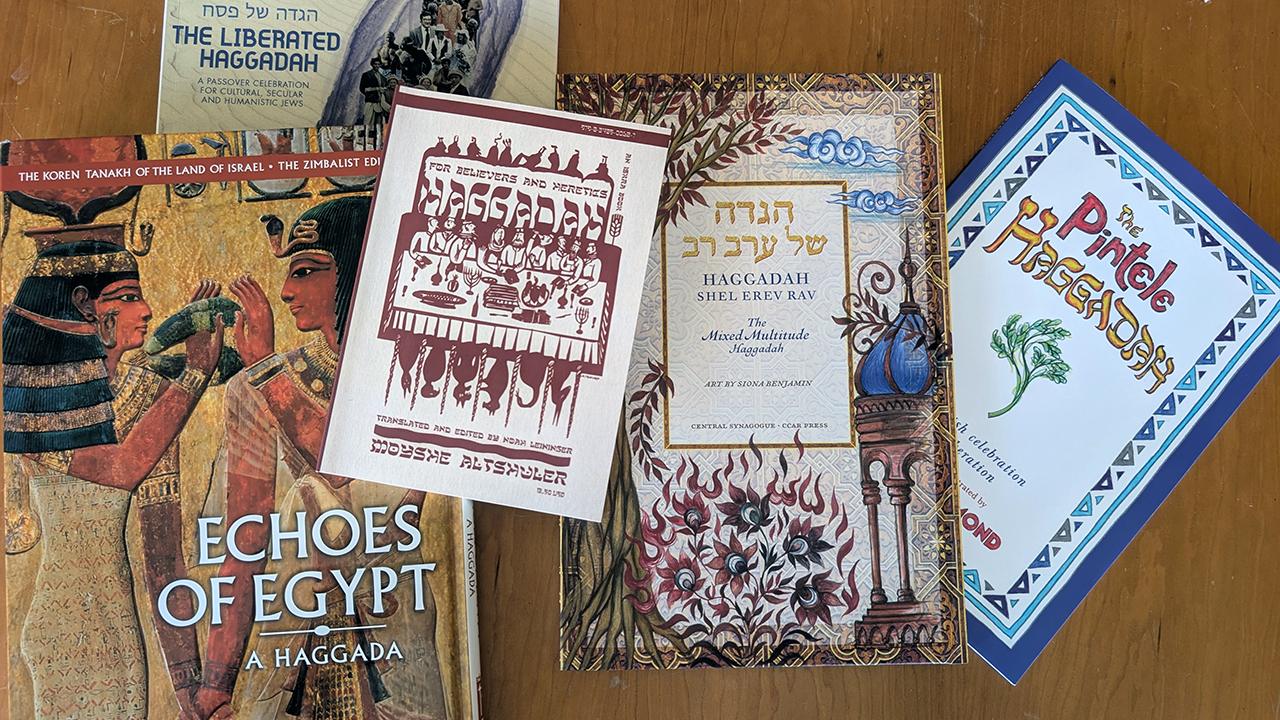
Every year, a raft of new haggadahs promise to enliven your Passover seder. And every year, I select a range of them for this little roundup of new haggadahs.
In this year’s crop, I spotted a theme running through several of them: What does it mean to believe in the text of the haggadah, in a modern context? Can one believe in its meaning without believing in its literal truth? Is it dishonest to use a haggadah that assumes the truth of the Exodus story if you don’t yourself believe in its literal truth? Answers, direct and indirect, follow.
“Echoes of Egypt: A Haggada” by Joshua Berman
If you accept the literal truth of the Passover story — that 3,500 years ago around 1400 BCE, hundreds of thousands of Hebrew slaves escaped Egypt after 400 years of bondage via the splitting of the Red Sea — then the premise of “Echoes of Egypt” makes perfect sense. This haggadah, by Bar-Ilan University professor Joshua Berman, supposes that we can better understand the story by placing it in an ancient Egyptian cultural context via archaeology.
This new haggadah is indeed replete with fascinating tidbits about ancient Egypt. Unfortunately, two centuries of academic consensus, from archaeology to linguistics, have shown us that the Book of Exodus was not drafted when and where it was supposedly written, but rather it was produced over centuries and was codified into its final form around the 5th and 4th centuries BCE, and not in Egypt. It is properly understood not as true history, but as meaningful myth. To understand the story in its proper context, we need to understand the time and place it was written — 5th and 4th century BCE Israel, not Egypt 1,000 years earlier.
“Echoes of Egypt” is full of non sequiturs and faulty, grandiose assumptions. In the introduction, there is a promise to deal with “questions at the very heart of Torah’s encounter with Egypt,” one of which is “Why did the Egyptians find no meaning in the unfolding of history?” I can’t make sense of the question, let alone take it seriously. There are plenty more like that throughout.

Some of Berman’s assumptions rest on the most tenuous of connections between ancient Egypt and the Exodus text. At one point, he tells us that the Biblical character Korach, whose name means “bald,” must have been an Egyptian priest because “during the period when Israel sojourned in Egypt… the lowest level of priests, the wab priests, were known above all by one distinctive feature — their shaved heads.” That’s a little too tidy and hardly proof of anything.
There is some truth to this next bit from Berman’s introduction: The haggadah “was a voice — indeed, a protest — against the great empires or the ancient world, and most of all against Egypt.” Yes, the haggadah is a protest against empire and oppression. But we need not take the story literally to see it that way.
“The Liberated Haggadah: A Passover Celebration for Cultural, Secular and Humanistic Jews” by Rabbi Peter H. Schweitzer
Taking the exact opposite approach, “The Liberated Haggadah” takes great pains to let readers know that it doesn’t take this story or any of its associated theology literally.
It is a reissue of a classic among the Jewish Secular Humanist denomination by the late Rabbi Peter H. Schweitzer, who was the rabbi of the City Congregation for Humanistic Judaism in New York. The Secular Humanist movement takes it as a settled matter that the entire Torah is nothing more than myth and that God is, at most, metaphorical.
The introduction asks, “If, in the face of modern scholarship, we no longer accept the Exodus narrative as historical, but as legend, why do we continue to tell the story? And if we do re-enact the story, how do we maintain our intellectual honesty?” The first question is a good one, while the second one is where Secular Humanism always loses me. Why can’t we enact Jewish ritual while also treating much (or even all) of it as metaphorical? That’s not intellectual dishonesty to me. That’s simply another mode of religious behavior.
But if that contradiction does bother you, “Liberated” is the haggadah for you. Throughout, it goes out of its way to let you know that nothing here is literally true. Earnest attempts are made, as Secular Humanism is wont to do, to rewrite prayers and blessings so that they remain ritual formulas without appealing to a higher power. For example, rather than the standard blessing over the candles, this haggadah offers “Baruch ha’or ba’olam. Baruch ha’or ba’adam. Baruch ha’or bayom tov,” meaning “Radiant is the light of the world. Radiant is the light within each person. Radiant is the light of the festival.”

My favorite thing about this haggadah are the photos of myriad tchotchkes, knicknacks and ephemera from Schweitzer’s extensive personal collection of Jewish Americana, including everything from brochures for Catskills resorts to a Hebrew National promotional clock.
“The Pintele Haggadah: A Jewish Celebration of Liberation” written and illustrated by Noah Diamond.
Personally, I’m not looking for ambivalence and cute jokes in my seder, but if you are, consider “The Pintele Haggadah,” which takes a middle path between “Echoes” and “Liberated.”
“I stopped celebrating Passover many years ago,” writes Noah Diamond in his introduction. “I had always assumed that there was a sound historical basis for the general idea that the ancient Hebrews were slaves in Egypt, and it broke my heart to learn that there wasn’t…. Working on ‘Pintele’ [also the name of his podcast] helped me realize that … at its heart, Passover is a celebration of liberation. It provides the poetic and philosophical framework for the Jewish imperative to oppose tyrants and be allies of the oppressed.” Here, remarkably, even this self-described “nonreligious nonbeliever” agrees with Berman’s overall take in “Echoes of Egypt,” even if Diamond fundamentally disagrees on the historicity of the Passover story.

Where he loses me is his insistence on pointing out what “our ancestors” did, removing himself and his audience from the equation of what we all do on the seder night. In the opening pages of the haggadah, Diamond has the leader read out: “When our ancestors lit candles, they would say a prayer in Hebrew.” He places the practice in the past, but then he writes out the blessing for lighting Passover candles anyway. Why not just print that blessing on its own, without implying that it’s a silly thing from the past? People can choose to say it or not, object or not.
I find the ambivalence about the proceedings odd in a haggadah. But for many seder attendees, I think this will work, as it gives people explicit permission to participate or not according to their own will.
Diamond structures the entire thing as a responsive reading, with chunks to be read by the leader and chunks to be read by the entire group. There is a jokiness to some of these sections. For example: “Leader: This is matzo, the bread of affliction. Group: This is matzo, the bread of affliction. Leader: I just said that. Group: I just said that. Leader: Now cut that out! Group: Now cut that out!” Moments later, he has the group inform the leader: “You know, they also have chocolate-covered matzo. It’s available wherever matzo is sold.”
“Haggadah for Believers and Heretics” by Moyshe Altshuler, translated and edited by Noah Leininger
This one is less a rejection of the literal truth of Passover than a rejection of the holiday itself. The “Haggadah for Believers and Heretics” is my favorite type of “new” haggadah — a republication of an old, obscure haggadah that illuminates the lives and beliefs of Jews in far-removed times and places. This one is a new translation of a Communist Yiddish haggadah published in the Soviet Union in 1927. (This new edition actually came out in 2025, but I didn’t get my hands on it in time to review last year.)
Its overall ethos is summed up nicely on the page for Yachatz, the breaking of the middle matzah, which includes simply an illustration and these words: “Humankind is divided into two camps: workers and parasites.”

This haggadah is both a political reimagining of the seder and a rejection of the seder itself. Its commentary on the famous line “this is the bread of our affliction” reads: “For poor bread, every capitalist has bought our sweat and blood.… Our Jewish masters, respectable bosses and rabbis, taught us to be patient…. They have turned their holidays into a means for binding and enslaving the people.… instead of actual history, they have taught us the Haggadah and Books of Moses.”
Despite its deep engagement with religious texts, it is resolutely anti-religious in classically Communist way, proclaiming at one point that the haggadah is a “tale of freedom, so as to hold you longer in slavery” and a “condemnation of humanity’s own initiative and struggle for freedom.” Opiate of the masses indeed.
My sense is that this volume is intended more as a primary source for understanding communist Jews of its time and place than for use at your seder. That said, of the new haggadahs I reviewed this year, it’s the only one formatted well for use around a seder table crowded with plates, glasses and ritual foods — i.e., it’s small enough that it won’t take up half the table, even if everyone has their own copy.
“Haggadah Shel Erev Rav: The Mixed Multitude Haggadah” edited by Rabbi Sarah Berman with art by Siona Benjamin
Finally, one of the most significant new American haggadahs this year is not particularly concerned with the debate over Biblical literalism, perhaps because it is produced by the Reform movement, which long ago decided that these stories aren’t literally true.
“The Mixed Multitude Haggadah” is produced to mark the 20th year of Rabbi Angela Buchdahl’s service to Central Synagogue in Manhattan. Buchdahl is one of the leading voices of the contemporary Reform movement and is well known as the first Asian American rabbi. The commentary is by her and other Central Synagogue clergy.
The English translations are written by Rabbi Janet Marder, rabbi emerita of Congregation Beth Am in Los Altos Hills, and her husband, Rabbi Sheldon Marder, who served as rabbi of the San Francisco Campus for Jewish Living before retirement.
The real draw here, however, is a wealth of new artwork by Siona Benjamin, an Indian American Jew, who grew up in India’s Bene Israel Jewish community. Her heritage is evident in her painterly work, in which mandalas, blue-skinned figures and her use of color recall the artistic milieu of India. My favorite pieces are her multi-page treatment of the 10 plagues, each represented by an abstract mandala, colored and detailed to represent each plague; the one for frogs is green, and two little frog legs protrude from it.

Noting the byzantine complexity of the Magid (storytelling) section of the seder, “Mixed Multitude” offers four relatively brief approaches to it that seder leaders can choose from: “Magid for All Ages,” which is especially appropriate for children; “With a Mighty Hand and an Outstretched Arm,” which focuses on God’s role in the story, the most traditional approach; “Go Down, Moses,” which focuses on liberation, “not just for the Israelites, but for all people in all times”; and “Miriam’s Song,” which tells the story of the Exodus from Miriam’s perspective.
That mixed approach is reflected in the name. In her introduction to the volume, Buchdahl writes of the many ways Jews celebrate Passover.
“That multiplicity is not a modern invention — it has been with us since the Exodus itself,” she writes. “The Torah tells us that when we fled Egypt, we did so as an erev rav, a ‘mixed multitude’ — a diverse assembly of Israelites and fellow travelers, all swept us in a shared yearning for freedom.”
And with that, let me wish you and your mixed multitude a meaningful seder this year, no matter which new, old or cobbled together family haggadah you use.
Also new this year
There are two other haggadahs of note this year that I could not get my hands on in time for this review:
“A Living Tapestry” by Leon Fenster
Fenster is a British artist whose explosively vibrant, graphic-design-influenced art appears to leap off of every page of his new haggadah. I really wish I had a copy in hand!
“The Az Nashir Haggadah: On the Path to Redemption”
This haggadah comes from the Matan Institute for Women’s Torah Studies in Israel. It features a range of contemporary art, prayers and commentary from Israeli Orthodox women scholars.
One more thing
Sometimes I’m asked, after all these years of writing about new haggadahs, which one do I use? The answer is the “The Yedid Nefesh Haggadah” by Rabbi Joshua Cahan. It is lightweight, straightforward and features a solid commentary meant to elucidate the text of the haggadah. It also comes in a spiral-bound edition that folds over and lays flat so as not to take up too much space on the table. I recommend it to just about anyone.