

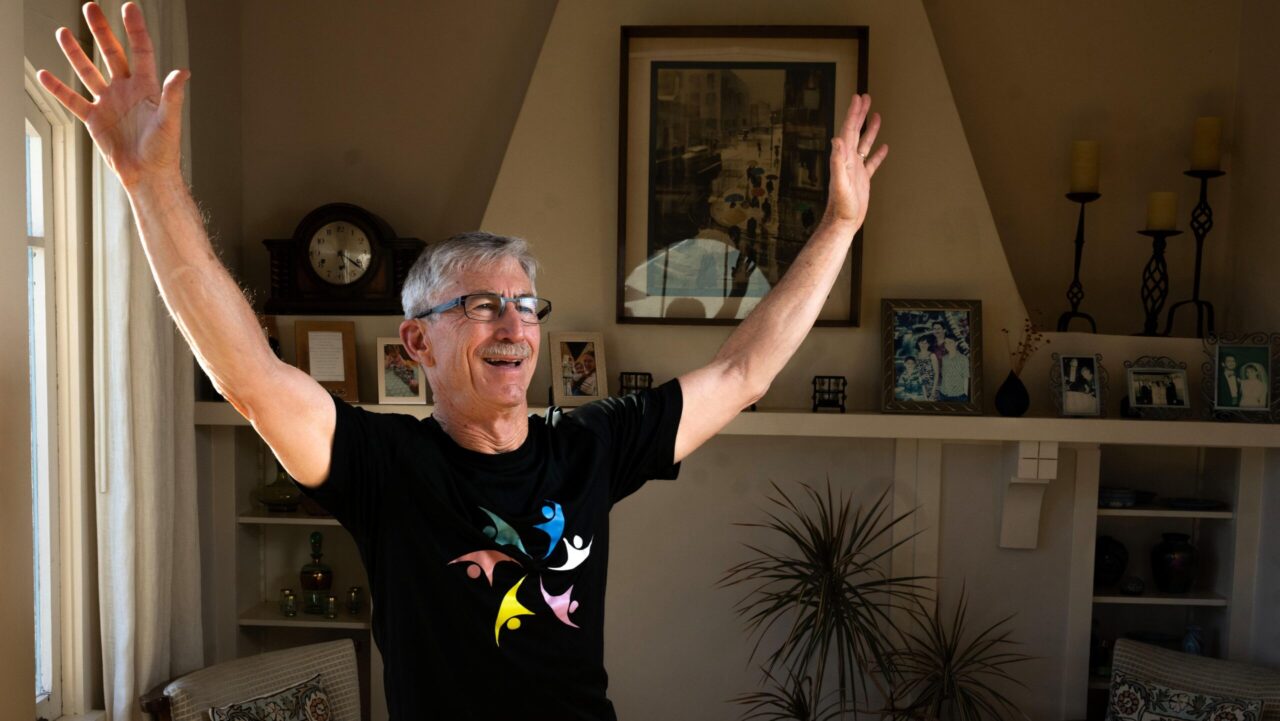
Allen King loves to dance. The Bay Area native has been leading Israeli folk dancing across the region for decades, and, at 73, has no plans to stop.
Both as a performer and as a teacher, King estimates that he has touched many thousands of lives at countless events, b’nai mitzvah and community dance circles.
“The research shows that dancing is one of the most all-encompassing physical and mental activities a human being can do,” he said. “I can give that to people and engage them and get them feeling so happy.”
King, a former member of the venerable San Francisco folk dance troupe Rikudom, now dances and teaches in the East Bay. In Kensington, he teaches through Cafe Simcha and in Berkeley at the music and dance venue Ashkenaz, where he runs a special class a few times a year focusing on the old-school dances he first learned.
Israeli folk dance burst onto the Jewish American culture scene in the 1960s and has continued to thrive as what’s been called an “embodied identification with Israel.” Israeli folk dancing, along with singing, has also shaped generations of Jewish campers.
That’s certainly true for King.
Though he made his living at a Bay Area distributor of paper packaging before retirement, King said that his life has always revolved around dance. It is not only the core of his Jewish identity, it is the way he gives back. For him, it’s about seeing the joy on people’s faces after a dance session.
“They remember the happiness they had when they were dancing, how good a time they had,” the Berkeley resident said. “Because there’s nothing like the endorphins of dancing.”
This interview has been edited for length and clarity.
Tell me a bit about where and how you grew up.
I grew up in Richmond, California, and we belonged to Temple Beth Hillel, which is a Reform synagogue.
My life growing up was not super happy. There weren’t a lot of Jewish people in Richmond, and certainly in my schools there were almost none. But I was proud of being Jewish. My parents taught me to be proud. My mother was a Holocaust survivor who was in hiding during the war, and my father fought in the war. So I had a strong awareness of who I was.
One of the highlights was in sixth grade. Every year at public elementary school, they would have a Christmas program and all the kids would sing various Christmas songs. And I asked the teacher, let me do a Hanukkah song because I celebrate Hanukkah, I don’t celebrate Christmas. And the teacher said yes, so we did a Hanukkah song, and they continued that tradition afterward. This was in the late ’50s, so very recently after World War II. It was a big deal to me.

It was camp — Camp Saratoga, as it was known at the time, later Camp Swig and now Camp Newman — that introduced you to Israeli folk dance, right?
I signed up for dancing because I just thought it’d be fun. And it turned out I finally found one thing in my life that I was physically good at. Rather than being the last kid picked for kickball in fourth grade, I could do folk dance, and I was competent. It was a huge deal.
That experience with dance changed my life, literally, and I’ve been dancing ever since.
So it wasn’t just a summer fling?
It was too big of a part of my life to ever end it.
I became part of the Rikudom dance group in 1969, and three months later, one of the people in the performing troupe invited me to become a partner in the performing troupe. I was in that group until the group ended in 1994.
In the meantime, in 1972-73 I was a junior at UC Berkeley and I decided I wanted to do a junior year abroad. I didn’t have much connection to Israel. I was a strong Jew, but I didn’t know much about Zionism.
So I said, I’ll go to Israel to the Hebrew University. And that was another awakening. The homeland of Israeli folk dance was quite amazing. I ended up signing up for a course to get certified as an Israeli folk dance teacher for Israeli public schools, a year-long course, all in Hebrew.
I saw a sign on some telephone pole about tryouts for a dance troupe, so I tried out and was accepted as a troupe member for Lehakat Hora [now called Hora Yerushalayim], the hora dance troupe of Jerusalem, which is still in existence. I performed for tourists every Thursday night.
That was a year of study and music and dance that was just out of this world.
You got a job to pay the bills, but you kept dancing. What kept you going?
When I came back, I decided dance would always be my life, and I taught and led [dancing at] maybe 100 or 150 bar mitzvahs and bat mitzvahs over the years throughout the Bay Area.
I saw when I taught dance and did dance, it brought joy to people. It brought multiple generations together on the dance floor. I run into kids now, 30, 40, 50 years later, where I led dancing at their bar mitzvahs. They don’t remember anything about the party other than that the dancing was so much fun, and their grandpa or great-grandpa was on the floor with them dancing. I mean, these are memories. I create memories for people when I’m dancing.
You’re 73. What does your dance life look like now?
I’ve been retired now for six years. I turned 73 last November, and I’m still dancing. For the last 35 years, [Cafe Simcha has] been up in a church in Kensington, and I’m part of the committee that runs that evening.
What’s it like to step into a communal Israeli folk dance night?
People welcome you: “Hi. Where are you from? Have you ever danced before? Oh, if you haven’t danced before, dance next to me. Let me help you.”
Sessions are different, and I will tell [people] that, you know, after an hour or so of trying and working and thinking really hard, you’re going to be tired. But that doesn’t mean that you have failed. You succeeded. You came and you danced.
When you listen to a song, it’s not just one part of your brain; every part of your brain is activated. Research shows dance is the same thing, because first, we have the music, plus you’re learning new steps. And how many people learn new things as they get older, right?
People walk in the room because they want something. They want a community, some place to go out at night, to do something for themselves and get some physical activity. Maybe they didn’t know what they wanted.
They can get all of that there. Folk dancing is a very gregarious activity, and people don’t judge people for their skill level. They just welcome them.
I can go dancing anywhere in the world and find someone that I know. It’s really remarkable.