

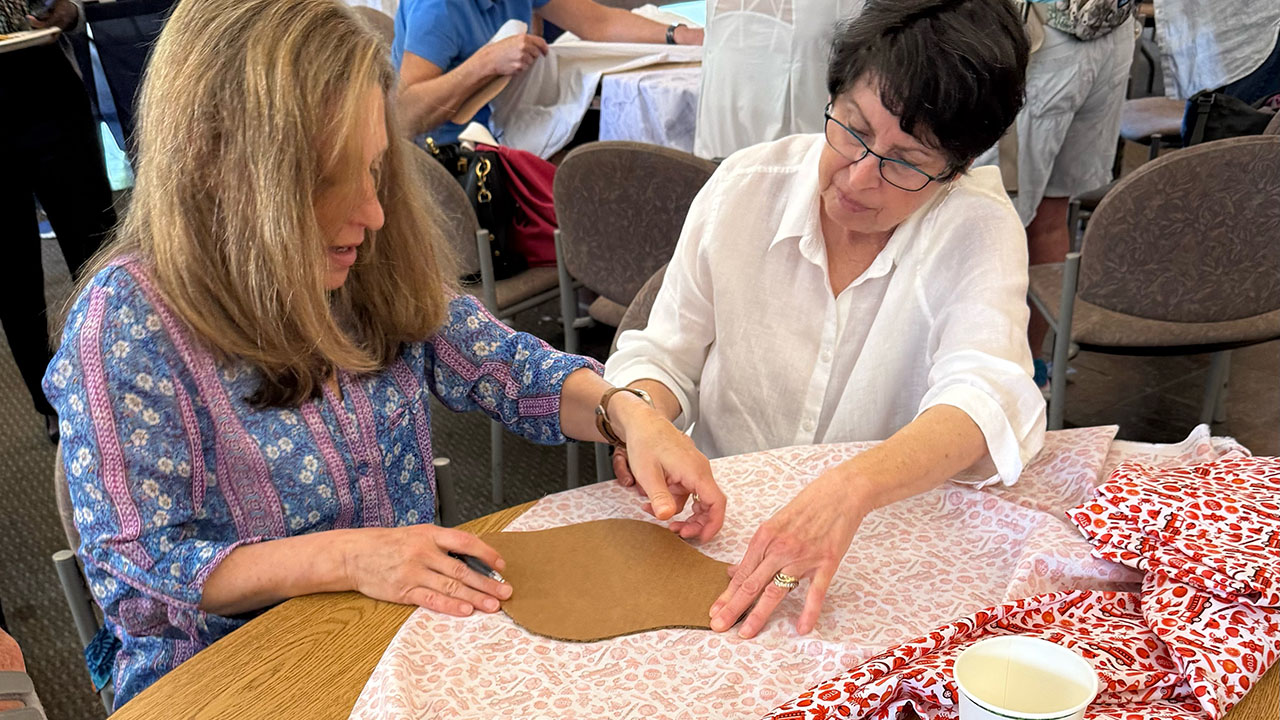
On a recent Sunday afternoon at Congregation Beth Am, I grabbed scissors and cut cotton cloth into oblongs for reusable menstrual pads.
In rural Uganda, where the pads are destined to go, around 22 percent of girls “drop out of school due to period-related issues,” according to Uganda-born Rabbi Shoshana Nambi, the assistant clergy at my Reform synagogue in Los Altos Hills.
It’s not just a matter of cramps and discomfort, although those are issues, said Nambi, who led a Beth Am group to Uganda in December. It’s the cost and availability of menstrual supplies, and the fear of embarrassing stains and teasing.
Combating local taboos, the Casa Uganda Foundation is determined to keep young women in school. One way is through its “reusable sanitary pad initiative” to ensure “no girl misses school due to lack of menstrual hygiene products,” according to the website. “Every pad is a step toward equality.”

Susan Kramer, a longtime Beth Am Women’s board member who traveled with Nambi on the trip to Uganda, helped bring the project back to the congregation. With volunteer cutters and reams of cloth donated by congregants and Britex Fabrics, the Mitzvah Day project in late March resulted in 2,600 pieces of fabric prepped for shipping to Uganda.
In rural Uganda, “access to sanitary hygiene products remains one of the biggest challenges,” according to Nambi, who grew up in the Abayudaya Jewish community of eastern Uganda and is that country’s first woman to become a rabbi.
“Our families did not talk about menstruation at all,” Nambi told me in an email. “The only thing I remember is my grandmother talking to me about what to do when you have bad cramps. I remember feeling so embarrassed and not wanting anyone to know, because once you had your period, you were a woman now. I remember just wanting to be a child.”

My own memories turned back to preadolescence, when we whispered about “monthly visitors” that kept girls out of the swimming pool. Some of our questions were answered in a glib presentation I was forced to attend, along with reluctant 10-year-olds in my Girl Scout troop. Our bodies were being prepared for womanhood. And like the rabbi, I didn’t want any part of it.
“Janet, it’s the most important thing in a girl’s life!” my mother exclaimed.
“No, it’s not!” I insisted, wondering if womanhood would be an inevitable downhill plunge.
Since mothers couldn’t always come up with explanations that made sense to 10-year-olds, Disney, with help from Kotex, stepped into the fray with a 10-minute menstrual movie that was screened at the Girl Scouts’ event.
In the cartoon, we watched the eggs wend their way from ovary to fallopian tube into the uterus, which looked like the cross section of a pear. They were eventually expelled through the vagina. Intercourse was never mentioned. Nonetheless, the cartoon ended with a bride and a baby.
“Sally and Mary and Kate Wondered,” a modest 1956 booklet produced by Modess, grappled with all the things certain girls didn’t do on “certain days,” such as swimming and horseback riding. “But the greatest thing to look forward to is the time when you will be a grown woman and have children.”
Yuck! At age 10, if I could have found a way to stop the clock, I would have. But at least I knew what to expect — unlike my great-aunt Lillie, who tossed her soiled underwear into the river and thought she was dying before she finally went crying to her mother.
“I was so embarrassed,” she told me.
And when my grandfather was courting my grandmother, her sisters would send him away when she suffered from menstrual cramps.
“She ate hot dogs,” they would tell him. Her younger brother wondered why she continued to eat hot dogs when they obviously didn’t agree with her.
While I was growing up, pregnant silences were often replaced by other euphemisms. Full-page magazine ads featuring glamorous women in ballgowns were captioned with two words: “Modess… because.”
Because what? The silence is screaming the shame.
Such taboos, as well as period poverty, aren’t just an issue in the developing world.
In our own country, the Pad Project, the Alliance for Period Supplies and I Support the Girls provide free menstrual supplies to girls and women in need.
With that in mind, during Beth Am’s Mitzvah Day, the S.F.-based Jewish Family and Children’s Services worked with the synagogue to collect and distribute sanitary supplies locally.
So far, 27 states, including California, have passed legislation requiring schools to provide free menstrual products, according to the Alliance for Period Supplies. It’s about time.