

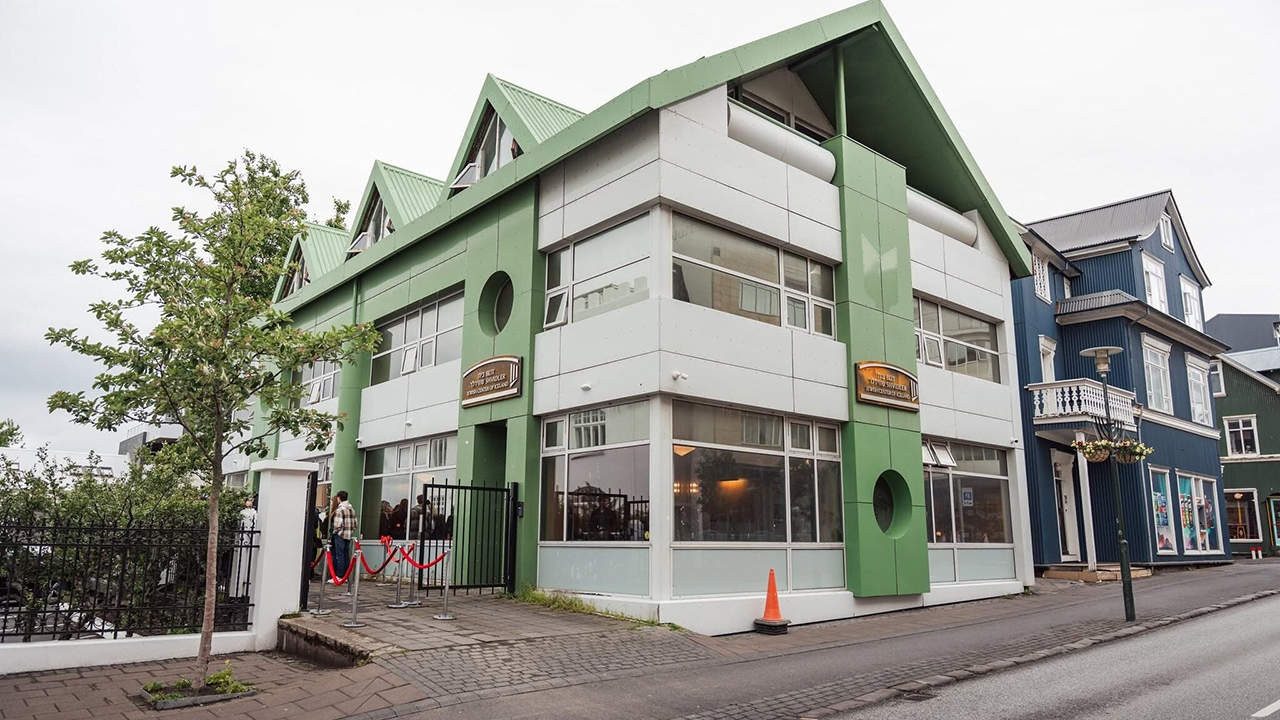
(JTA) — REYKJAVIK, Iceland — Until recently, this city located near the Arctic Circle was one of the few places in Europe where organized Jewish life did not exist — no synagogue, no ritual bath, no communal building. That changed this week, as the Jewish community in Iceland opened the Beit Shvidler Jewish Center of Iceland, the country’s first-ever Jewish center.
The center is housed in a renovated, roughly 9,000-square-foot building in downtown Reykjavik that once operated as a bar and, before that, as the headquarters of a political party. It sits just minutes from where the husband-and-wife team of Rabbi Avraham and Mushky Feldman have lived and worked since arriving on the island in 2018. The project has been funded largely through community donations.
The center includes a synagogue, a seminar room seating nearly 80 people, a kosher shop, a community kitchen, a youth center, a library lounge and a security center, amenities the community has never had access to in one place.
There is also a mikvah, or ritual bath, that is heated geothermally, using the abundant underground volcanic heat that provides much of the country’s power.
“Jews here were yearning for a synagogue, for a rabbi, for some sort of a community,” Avraham Feldman said of the years before the couple’s arrival, “and it has been amazing to fill that need.”
Community members agree.
“Iceland has a highly diverse, dispersed and diffused Jewish community; given that we’re an isolated island, we all kind of washed up here,” said Michael Klein, an American Jew living in Iceland since 2020.
“The Feldmans managed to pull together the resources, the building and the work to turn a disused political party headquarters and restaurant into a Jewish center that can serve not only our small community but the far larger group of visitors from all over the Jewish world who come for our natural beauty and peaceful isolation,” added Klein.
Jewish life in Iceland has always been sparse and intermittent. Jewish traders are known to have passed through as early as the 1600s. Still, the organized Jewish presence dates to the late 1800s, and the first practicing Jew believed to have settled permanently was Fritz Natan, a businessman who, in 1917, built Iceland’s first five-story building.
For decades afterward, Jewish life in Iceland survived on the efforts of a handful of dedicated volunteers who coordinated informal gatherings, often meeting in rented spaces or in the basement of Hallgrímskirkja, the country’s most recognizable church. The U.S. Navy base in the town of Keflavík, near the international airport, occasionally provided Jewish chaplains until it closed in 2006. But there was still no permanent institution, no resident rabbi, and no dedicated building, a gap that led some to call Reykjavik the only European capital without a synagogue.

That began to change in 2018, when the Feldmans relocated from the United States to Reykjavik to establish a Chabad-Lubavitch presence, becoming Iceland’s first permanently stationed rabbi and his wife in the country’s documented history of a thousand years. The couple started small, hosting Shabbat dinners and holiday services out of their living room. Estimates of the community’s size hover around 300 self-identified Jews, out of Iceland’s total population of about 400,000.
Momentum built quickly. In 2020, the Jewish community celebrated its first native Torah scroll, commissioned by a donor in Switzerland and completed with the help of the Icelandic congregation. A year later, the Icelandic government formally recognized Judaism as an official religion, opening the door to officially recognized Jewish weddings and allowing residents to direct part of their religious tax to the community. How many have done so is not public information.
By 2024, the community had outgrown its rented rooms and church basements and purchased the building that became the new Jewish center, roughly tying one in Fairbanks, Alaska, as the northernmost Chabad houses in the world. The building sits in Reykjavik’s compact downtown, just blocks from the iconic Rainbow Street and Harpa Opera House that make the city one of the most Instagram-friendly sites in the world.
In a city that caters to tourists, and for a community built largely from immigrants, longtime Icelandic Jewish families, and people who married into Icelandic life, the new center represents something rare: a shared physical home.

“It’s been clear for a long time that we need a home for our community,” said one Jewish resident in Iceland, who spoke on the condition of anonymity because not all of his colleagues know he is Jewish. (Iceland’s relatively small number of Jews means that there is little record of antisemitism; anti-Israel sentiment is strong, with the country one of five to boycott the Eurovision song contest this year over Israel’s participation.)
“It’s not like we’ve been hiding or aren’t a strong community; we celebrate holidays together, and there are Shabbat dinners,” he continued. “But I think it’s important that we have this center. Seeing it opened is very moving and important.”
Like many Jewish institutions in Europe, the center will ensure security by being open only to members of the community or visitors who reach out in advance.
Avraham Feldman said the space will hold a display case with three small prayer books donated by early Jewish residents, the only known surviving physical remnants of Jewish life in Iceland before his arrival, a reminder of how recent, and how hard-won, this permanence has been.
“The result of this center is a combination of home, family, and permanence that was unimaginable when I started visiting 14 years ago and was only a mere dream when I moved here in 2020,” Klein said.