

Book coverage is supported by a generous grant from The Milton and Sophie Meyer Fund.
From our ancient past to now, the Passover seder has been an ever-evolving ritual, constantly tweaked by Jews in different times and places. The haggadah, the guidebook to the seder, continues to evolve, too. Once again this year, I scoured the internet for new haggadahs published in 2024 and came up with these five, each unique and interesting in its own way. (See my previous reviews in 2023, 2022, 2021 and 2020.)
“The Yedid Nefesh Haggadah”
 If you’re looking for a contemporary, general purpose, traditional haggadah, this is a great option. Created by Rabbi Joshua Cahan, it is a follow-up of sorts to his 2009 Yedid Nefesh bencher, a similarly unfussy, useful volume. Commenting in the introduction upon the incredible variety of haggadahs available, Cahan writes: “Most new Haggadot distinguish themselves precisely by their innovative activities, discussion or illustrations. But when it comes to a Haggadah for all participants at the table, I have found that most families look for a book that is easy and pleasant to use, making the Haggadah text clear, user-friendly and easy to follow.” Amen.
Which is not to say there is no commentary. There is plenty, but it’s unobtrusive — brief signposts and explanations that focus readers on the seder ritual itself and its manifold symbols. There are illustrations — almost doodled little vignettes by British artist Tilla Crowne — that don’t detract from the clean layout.
This haggadah is actually meant to be used in a full set around the table, unlike so many that are unwieldy repositories of commentary and art the galaxy-brained seder leader can mine for meaning. It is also, blessedly, a size that works around the table, a slim paperback that doesn’t take up too much real estate on a crowded seder table.
“Fruits of Freedom: The Torah Flora Hagadah”
 From Biblical and Talmudic ethnobotanist Jon Greenberg comes this haggadah, which is both hyperfocused on its theme and expansive in what it reveals about the history and context of the seder itself. Greenberg’s expertise in the use, cultivation and preparation of different plants from the places and times that gave rise to the seder enriches the commentary in this haggadah with fresh and new (to me) insights.
From this haggadah, I learned that bread symbolized very different things in ancient Hebrew and Egyptian culture, adding to my sense of the contrast between the two cultures in the Passover story. I also learned that Hillel’s Sandwich was probably more like Hillel’s Burrito, that the bizarre plague of frogs may well have been a terrifying plague of crocodiles, and that something as simple as the non-availability of lettuce around Passover in some places led to a change in the very meaning of Maror. Photos and vintage botanical illustrations throughout supplement the text.
Greenberg’s sources range from classical Jewish texts to recent archaeological discoveries, making for a very learned commentary that is more wide-ranging than I expected. If food, ecology or farming interest you, pick this up — or if you’re simply interested in a solid new haggadah commentary.
“The Promise of Liberty: A Passover Haggada”
 The glossy cover features an illustration of the Jews crossing the Red Sea — under the triumphantly waving stars and stripes of the American flag. The editors of this volume, health care executive Jacob Kupietzky and Yeshiva University administrator Stuart Halpern, take to an extreme the proud tradition of conflating a modern American notion of freedom with the seder’s tale of national liberation, complete with pronouncements like “America found its Moses and Joshua in the form of General George Washington.”
There is, however, a unique approach (insofar as every new haggadah needs one in order to justify its own existence): the commentary presents examples of how different Americans have been inspired by the Exodus story, from abolitionists who found comfort in its tale of freedom from slavery, to the 1980s Soviet Jewry movement demanding “let my people go.” Barack Obama, MLK, Harriet Tubman, Thomas Paine, Emma Lazarus and King George III (being compared to Pharaoh) all put in appearances.
A ream of essays in the back comes from writers including former Forward opinion editor Laura E. Adkins, the eminent scholar of American Jewish history Jonathan Sarna and, yes, the late Joe Lieberman (co-authored with OU kosher division head Rabbi Menacham Genack). It’s heavy for a general-use haggadah because it is 250 pages long, each one glossy, but it won’t take up too much room on your table.
“The Human Rights Haggadah”
 If “The Promise of Liberty” was an exercise in American particularism, “The Human Rights Haggadah” is an exercise in universalism. The author, London-based Rabbi Shlomo Levin, has an MA in international law and human rights. There is a strain of commentary throughout that draws from classical rabbinic sources, but they’re not the same old tidbits you’ve read in other haggadahs; they’re well chosen to highlight the human rights theme. For example, in the Magid section, where the haggadah text quotes Genesis 15:13, “and they will go out with great wealth,” Levin brings in sources about paying reparations. And on the following page, there are notes on the Rome Statute, the international law that governs what human rights abusers must pay to victims — and leaves it to you to apply that to particular situations in America, Israel and elsewhere around the world.
One interesting quirk: Levin also places stately passages from international law next to the text of the haggadah, elevating the legal material to an almost liturgical status — a journey many Jewish texts have gone on.
It is a slim, large-format paperback with a kind of school workbook feel to it. If you’re the sort of seder leader who compulsively includes several of those “supplements” put out by progressive Jewish orgs on various injustices du jour, consider this haggadah as a comprehensive replacement.
2024 Asufa Haggadah
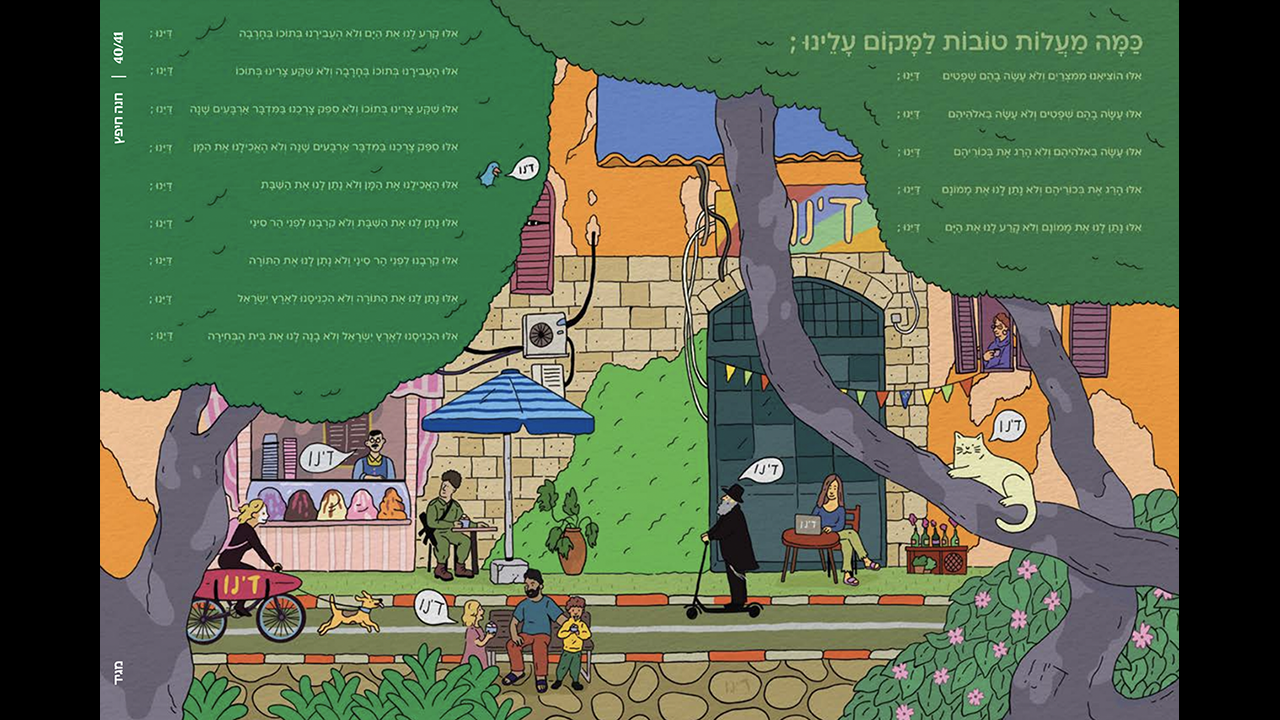
The Asufa Haggadah is an institution. Nearly every year for the past decade, a collection of Israeli artists working in a potpourri of styles collaborates on a new, vibrantly illustrated haggadah. Each artist gets a two-page spread to fill — the only requirement is that they include their page’s traditional text in the illustration. Styles include abstract and surreal, graphic designer-y and cartoonish and reinventions of classic illuminated haggadahs. Some pages are mostly text; others have only three or four words.
Highlights of the 2024 volume include the opening illustration for bedikat hametz, an image of a balloon animal made of bread set aflame; an arresting version of the Four Sons, with the wise son rendered as some kind of Jewish wizard wielding a seder plate; and a vibrant, modern Israeli street scene with passersby and birds in the trees all saying to each other, “Dayenu.” Buy a set to use around your (Hebrew-only) seder table — or do like I do, and make sure you grab the new one for your collection.

One more thing: If you want everyone at your seder to use the same haggadah, that can get pricey. The Jewish Community Library of San Francisco offers Haggadot in a Box — full sets of a single haggadah you can borrow. They have several to choose from, but my favorites are “A Different Night: The Family Participation Haggadah” and its follow-up, “A Night to Remember.”