

Food coverage is supported by a generous donation from Susan and Moses Libitzky.
Tu Bishvat, or new year for the trees, is a lesser known holiday among many Jews. (It starts this year on Feb. 12.) I did not celebrate it growing up in a secular community, but as I have formed my own connection to Judaism as an adult, it’s quickly become one of my favorites — not only for its themes around nature, but also for its connection to vegetarianism.
Tu Bishvat’s roots are as an agricultural festival marking the start of the spring season. For those passionate about a healthy planet and world, it can be a Jewish Earth Day, a time to advocate for the restoration of our planet. It is a day perfectly spent out in nature, going for a hike, preparing and planning your springtime garden, and enjoying foods known as the Seven Species or Shivat Haminim, sacred fruits and grains grown in Israel. Funnily enough, many of these crops grow and thrive in the California climate. The Seven Species are wheat, barley, grapes, figs, pomegranates, olives and dates, all items you are likely to find at your local farmers market.
As a nature and earth-based holiday, it is perfectly aligned with a plant-based diet. As a vegetarian Jewish chef, I’d be remiss if I didn’t use it as an opportunity to celebrate with a vegan menu that highlights the flavors and symbolism of these fruits and grains, native to both Israel and California. A plant-based diet can help to reduce environmental impact in a few ways, from reducing greenhouse gas emissions associated with animal agriculture, to conserving water. More important, it’s thought to be one of the leading solutions to slowing and halting climate change.
Over the past year of promoting my vegetarian Jewish cookbook, “Nosh,” I’ve seen that people are eager to reduce their meat intake, whether it be for health or environmental reasons. I often discuss its merits, and the benefits of following a plant-forward diet where the plants take center stage. Those who still eat meat can enjoy smaller portions, treating them as a side dish rather than the main attraction. This notion of plant-forward eating is a new way to approach a climate-friendly diet, removing many of the hurdles of a fully fledged vegan diet.
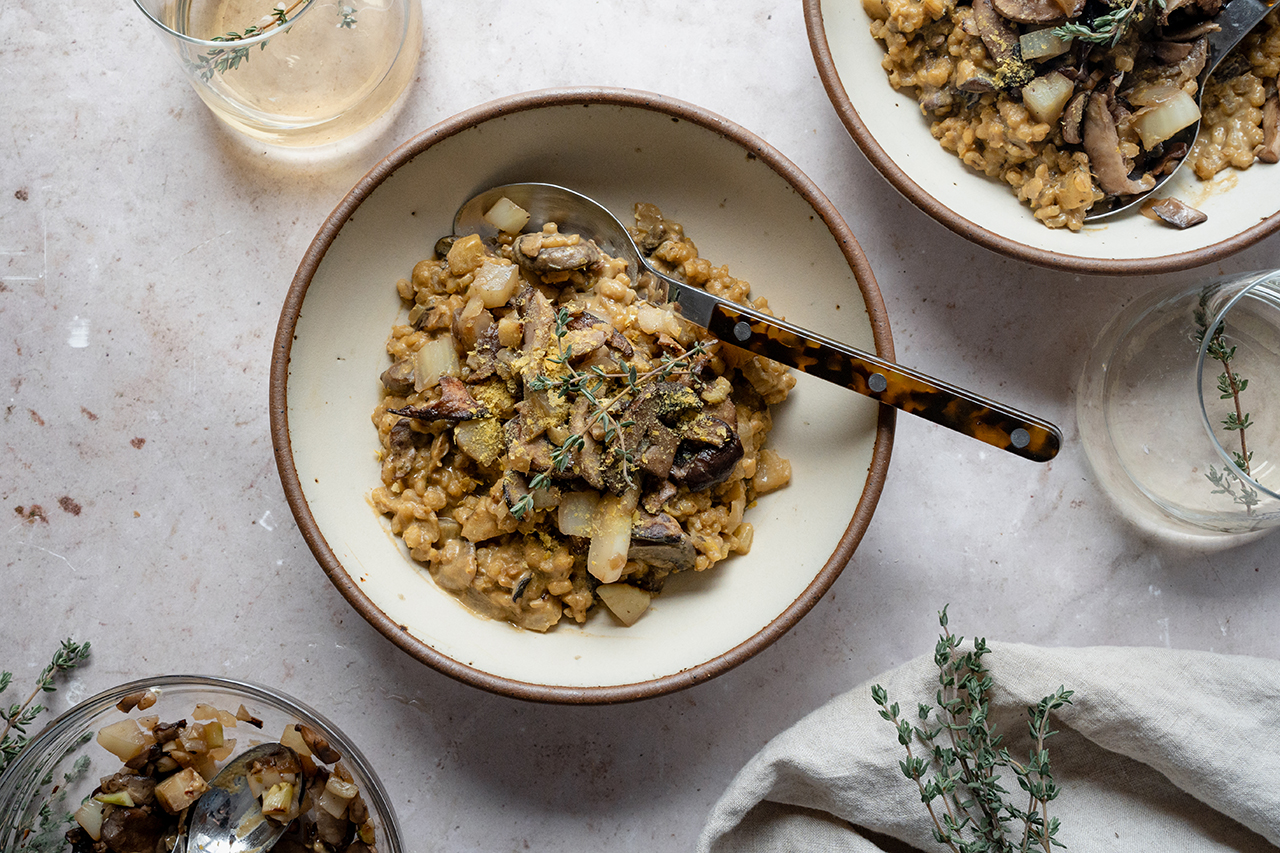
This hearty, vegan dish celebrates two of the seven species, barley and olives. Barley lends a chewy bite, similar to the al dente texture of arborio rice. In the absence of creamy cheese, I like to use a mixture of tahini, miso and nutritional yeast for a rich, almost cheesy flavor that pairs perfectly with the nutty barley for an irresistibly creamy dish. Fresh fennel adds a hint of sweetness, while earthy mushrooms provide both protein and umami flavor to this vegan risotto.
So, what are you waiting for? Tu Bishvat is the perfect excuse to ditch (or reduce!) the meat and try your hand at a satisfying, plant-based recipe, and you can enjoy the rest of the white wine while you’re at it. Chag sameach!
Vegan Fennel Mushroom Barley Risotto
Serves 4
Total time: 1 hour
- 6 cups vegetable broth
- ¼ cup tahini
- 4 Tbs. extra-virgin olive oil, divided
- 3 small shallots, finely chopped
- 6 cloves garlic, finely chopped
- 1 head fennel, finely chopped
- 12 oz. assorted fresh mushrooms, sliced
- 1 cup pearl barley
- ½ tsp. dried thyme
- 1 bay leaf
- ½ cup dry white wine
- ¼ tsp. Aleppo chili flakes
- 1 Tbs. nutritional yeast
- 1 tsp. miso paste
- Zest of 1 lemon
In a medium saucepan, heat the vegetable broth over medium heat. Once simmering, add the tahini, and whisk to combine. Keep on low heat.
In a large saucepan, heat 3 Tbs. olive oil over medium heat. Add the shallots and garlic and cook for 3 to 4 minutes, or until they begin to soften. Add the fennel and mushrooms and cook, stirring occasionally, until the mushrooms begin to brown, about 8 to 10 minutes. Remove half of the vegetable mixture and set aside.
Add the barley, thyme and bay leaf and remaining 1 Tbs. olive oil. Cook for 1 minute to lightly toast the barley.
Add the wine and cook until absorbed, about 4 minutes.
Add one ladle of the warmed broth and tahini mixture, stirring frequently to combine, until almost all of the broth has been absorbed. Be careful not to boil the liquid. Continue adding the broth, one ladle at a time, stirring and letting the broth absorb into the barley between each ladleful, until the barley is al dente. If you need more liquid, you can add warm water to finish cooking. Remove the bay leaf.
Add the Aleppo chili flakes, nutritional yeast, miso and lemon zest. Season with salt and pepper, to taste. Garnish with thyme.