

Updated at 6:10 p.m.
The advocacy group Jewish California was deep into the second half of the state legislative season, shepherding a slate of priority bills through the Senate last week, when it discovered that the California State University faculty union was moving to repeal the group’s signature achievement from 2024.
The California Faculty Association is backing a bill, AB 2551, by Assemblymember Sade Elhawary, a progressive Democrat from Los Angeles, that would lift restrictions on campus demonstrations enacted following the wave of student unrest over the war in Gaza.
Under a current state law, SB 1287, public universities must enforce time, place and manner limits on student protests. It also mandates that student codes of conduct explicitly prohibit violence, harassment, intimidation and discrimination.
The union is arguing that the current law has had unintended consequences, including a chilling effect on campus demonstrations and students being “disenrolled” for nonviolent violations.
“The California legislature has an opportunity to send a strong message to college campuses and the broader community by taking steps to protect free speech on campuses,” CFA said in a June 25 letter to the Senate Education Committee, which will hold a hearing on the bill on July 1.
Elhawary did not respond to a request for comment.

Jewish California, which advocates in Sacramento on behalf of 43 Jewish groups across the state, is calling the bill an “attack” on the Jewish community and mobilizing to stop it. On its side are the leadership of the University of California system and Hillel International, as well as the directors of all CSU and UC Hillel chapters.
“SB 1287 was the product of a public and transparent year-long negotiation process — hearings, testimony, amendments, and ultimately an overwhelming bipartisan vote,” David Bocarsly, CEO of Jewish California, said in a statement. “Jewish students across California are safer because of it.”
The legislation was introduced through a maneuver known as “gut-and-amend,” in which new language is inserted into a bill that has already cleared the Assembly, allowing it to skip the committee hearings that would have been required in that chamber. This means the July 1 Senate Education Committee vote will likely be both the first and last policy hearing the bill receives.
It’s not the first time the Cal State union, which represents 30,000 professors, lecturers, librarians and other staff, has clashed with Jewish advocacy groups.
In October, a CFA questionnaire sent to political candidates seeking its endorsement lumped together Jewish California, AIPAC and the oil and tobacco industries as groups that “harm working people.” (CFA has since issued an apology.)
This spring, CFA backed AB 2159, a failed attempt to gut a new law, AB 715, that seeks to curb antisemitism in K-12 public schools.
Jewish California views the pattern as evidence of prejudice.
“We said last time that CFA has an antisemitism problem,” Bocarsly said regarding this spring’s effort against AB 715. “Three strikes confirms it. This is not a policy disagreement — it is a sustained campaign targeting Jewish students and the community that advocates for them.”
Melina Abdullah, who heads CFA’s political action and legislation committee, criticized Bocarsly’s characterization.
“It is disgraceful that a stance to protect free speech on campuses would be twisted and used to apply hateful labels to the largest faculty labor union in the nation,” Abdullah said in an email to J.
The state Assembly passed the original version of AB 2551 in late May, sending it to the Senate. Then on June 11, Elhawary introduced an amendment that gave the bill its current shape.

Elhawary, a freshman lawmaker, is known for her work as a teacher and community organizer prior to taking office in 2024. Her district includes a majority of Los Angeles’ downtown and south central neighbors, which are working class and majority Latino.
The University of California opposes Elhawary’s bill, arguing in a letter to the Senate Education Committee that its existing protest policies were carefully developed to balance free expression with campus safety and civil rights protections and that AB 2551 would unravel this work and create confusion around rules only recently put in place.
The passage and signing of SB 1287 into law in late 2024 was a milestone for the California Legislative Jewish Caucus, which strongly supported the bill, as well as for Jewish California. In the midst of pro-Palestinian protests on college campuses across the state at which some Jewish students reported being intimidated, harassed or excluded from campus life, Jewish California rallied support for the bill among its member organizations.
The clash over the repeal bill comes as Jewish California and lawmakers in the Jewish caucus are supporting other bills during the current legislative session.

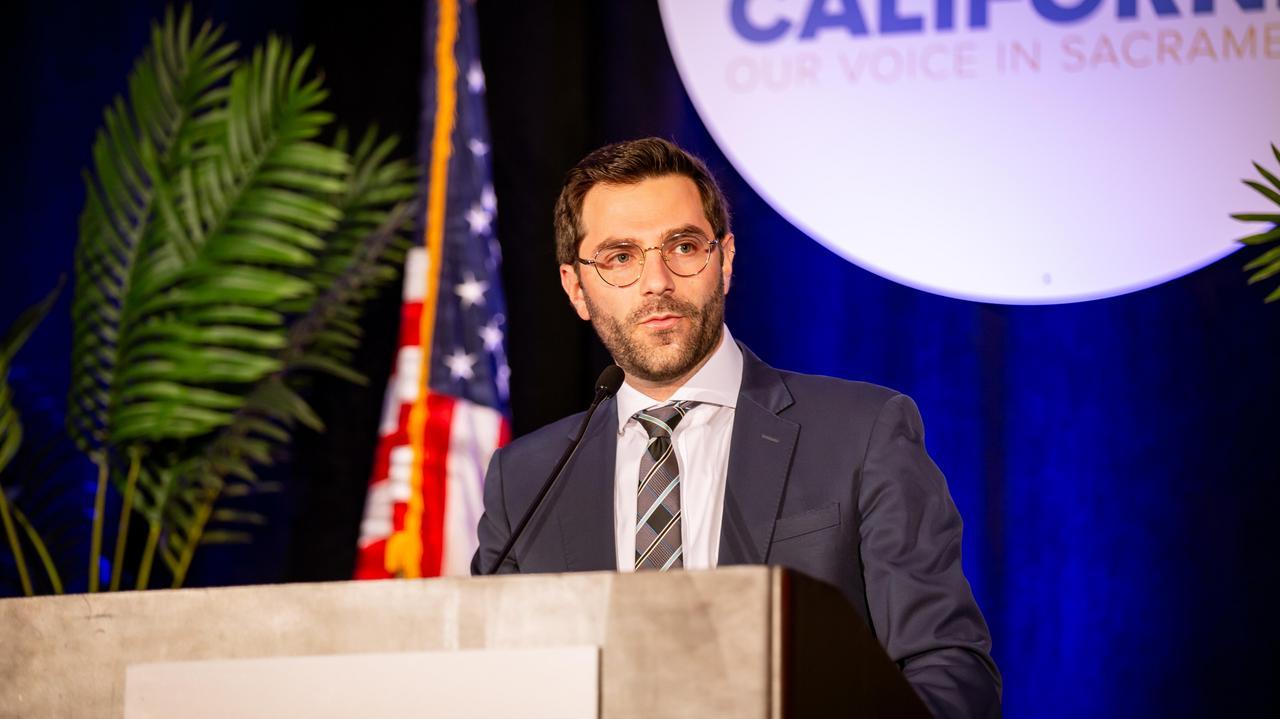
(California State Assembly)
- SB 1387,authored by state Sen. and Jewish caucus member Henry Stern (D-Sherman Oaks), requires state government forms that collect demographic data to include “Jewish” as an ethnic identity. Supporters say that better demographic data could improve responses to antisemitism. However, the bill has sparked debate online over concerns about how sensitive identity data is stored by the state. After passing the Senate in late May, it has been referred to the Assembly’s Appropriations Committee, which plans to vote on it in August.
- AB 1853 bars hate speech in candidate statements published in the state’s official voter guide. This is a response to the appearance of an antisemitic screed by gubernatorial candidate Don Grundmann in the guide for the June 2 primary election. The bill, authored by Assemblymembers Gail Pellerin (D-Santa Cruz) and Marc Berman (D-Palo Alto), seeks to limit candidate statements to only include information about a candidate’s own education, professional experience, public service, community involvement and qualifications for office. Pellerin and Berman are Jewish caucus members.
Grundmann asserts that the bill amounts to censorship, the Mercury News reported. - AB 2664, also known as the “Safe Worship Zone Act,” creates a 100-foot “buffer zone” for protests around entrances to houses of worship. If enacted, it would prohibit protesters from coming within 8 feet of congregants without their consent. Introduced by Assemblymember and Jewish caucus member Rebecca Bauer-Kahan (D-San Ramon), the bill comes in response to two protests in front of Los Angeles synagogues over the past two years.
Critics of the bill, including Jewish Voice for Peace and the California chapter of the Council on American-Islamic Relations, contest the assertion that the bill is only meant to protect the right to worship. JVP describes it as an effort of the “Israel lobby” to “ensure Israeli real estate companies can keep setting up shop inside synagogues to sell stolen Palestinian land to American Jews.” - AB 1836 asks the state to authorize $100 million of spending on its nonprofit security grant program. Authored by Assemblymembers Jesse Gabriel (D-Encino) and Chris Ward (D-San Diego), it also seeks to expand the program’s eligibility to include security for offsite events and for nonprofits that don’t own their facilities. Ward is a Jewish caucus member; Gabriel is its chair.
- AB 395, also authored by Gabriel, would require school districts and other state bodies to “make every reasonable effort” to avoid scheduling public meetings on religious holidays.
- AB 1763, co-authored by Assemblymembers Alex Lee (D-Milpitas) and Rick Zbur (D-West Los Angeles) would guarantee students excused absences for religious holidays and no longer require parents to obtain approval from a principal. Zbur is a Jewish caucus member.