

This story was originally published in the Forward. Click here to get the Forward’s free email newsletters delivered to your inbox.
The World Cup is in full swing. Cristiano Ronaldo, CR7 himself, is improbably, arrogantly playing his sixth tournament at the age of 41. The media loves it: the Lionel Messi vs Ronaldo rivalry continues. Ronaldo plays on with tears and tantrums, breaking records and refusing to simply grow old and go home.
But David Bolchover, author of “Digging Deep: Unearthing the Stories of Eleven Murdered Jewish Footballing Greats,” finds himself thinking about a different 41-year-old: Jozsef Braun. Arguably the greatest Jewish footballer who ever lived, he was killed by the very Hungarians who had once cheered his name.

“When he was murdered, he was 41,” Bolchover told me when we spoke recently. It was less than 15 years after he had last scored an international goal for Hungary — then one of the top few international teams in the world.
Millions of Jews across Europe were part of the burgeoning soccer culture that was sweeping the continent, with disproportionate representation among elite players, coaches and referees, The way Bolchover tells it, the Jewish soccer culture lost in the European Holocaust was as substantial as the foundational Jewish contributions to culture that helped bring western civilization into the 20th century.
Although he restricts himself to people who played for their countries and who were murdered in the Shoah, Bolchover has selected a team of greats in all 11 positions. He quotes Ursula von der Leyen, president of the European Commission, in 2022, saying “There is no Europe without European Jews,” but where she was thinking that “Europe is Mahler and Kafka, and Freud,” Bolchover is thinking Braun, Zygmunt Steuermann, Béla Guttmann and Arpad Weisz.
These were some of the elite players, coaches and visionaries of the sport — the Messis, Ronaldos, Pep Guardiolas, Zinedine Zidanes, and Carlo Ancelottis of their time. Indeed, Bolchover says that one significant reason that Hungary and Austria’s all-conquering soccer teams became second rate was that they murdered the Jewish populations who were instrumental in achieving and perpetuating that excellence. Dave Rich, who wrote about the UK release of the book, made a point that Bolchover says he wishes he had thought of himself: “Jewish footballers were as prevalent in the football leagues of central and Eastern Europe in the 1920s and 1930s as Black players are in the Premier League today.”
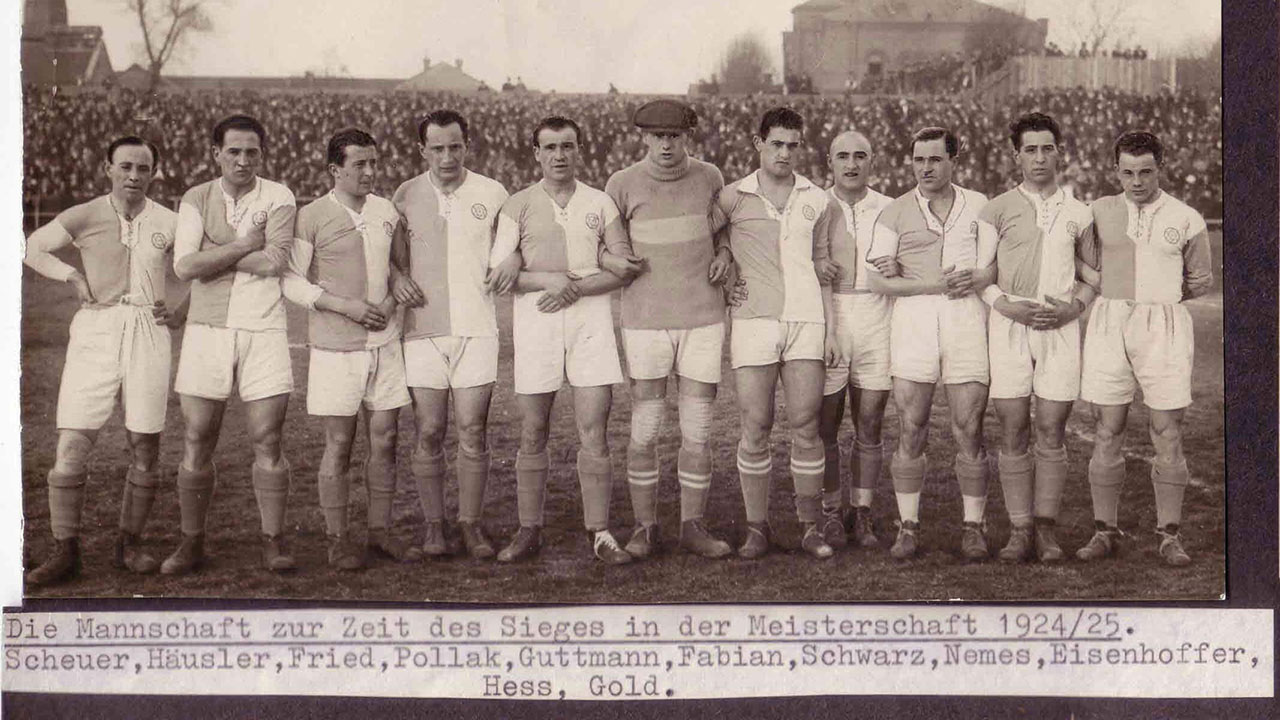
The team that Bolchover unveils in his book would strike fear into the hearts of any pre-War expert on European soccer. Wunderkind Steuermann scored Poland’s first ever international hat trick. Max Scheuer played his whole career for the Jewish, Zionist team Hakoah Wien and led them to the Austrian national title. Weisz went from international star player to record-winning coach, winning the Italian championship for Bologna and Inter Milan. He remains the youngest coach to win Serie A.
Across eight chapters, Bolchover tells the stories of his 11 selected players of his selection and, in so doing, tells a particular history of the Shoah. He can even ignore György Molnár and József Eisenhoffer who alongside József Braun, in 1924, were the Jewish players who scored Hungary’s first six goals as they humiliated Italy 7-1 in Budapest. But, along with the glory, it seems like on every page there are footnotes chronicling the tragic fate of the Jews in the towns and villages from which players, their wives, and their families hail.
“I’m not going to just mention a place where Jews lived and not tell you what happened,” Bolchover said. “To me, that’s an abandonment of responsibility. You often get non-Jewish English writers just letting it lie: ‘He was from this area and he died in Auschwitz.’ It’s not good enough.”
Bolchover deliberately avoids saying that these men “died” or that they “perished”; he says they were murdered. “Vocabulary is very important,” he told me. “You have to use ‘murder.’ You can’t use ‘died.’ Even ‘perished,’ I don’t like… I talk about the Holocaust as the Holocaust was. A Jew who’s not angry about the Holocaust is a strange Jew.”
Bolchover is also scathing about the nations for whom his protagonists played. He resists describing many of his players simply as Hungarian, Austrian or German. History, he argues, has already rendered its verdict. “The ones that thought they were Hungarian, the ones that thought they were German, the ones that thought they were Austrian were proven to be wrong,” he said. “They were rejected by the host societies… In the end, they were Jews.”
This is not a polite book. Bolchover does not soften his account for squeamish readers, and he does not traffic in the comforting framing that has come to dominate Holocaust memory in the West: the survivor, the righteous gentile, the redemptive arc. His previous book, “The Greatest Comeback,” told the story of Béla Guttmann — the brilliant Jewish coach saved by his future brother-in-law — and even that book, Bolchover insists, “did not pull any punches.” This one pulls even fewer. This one is about the rule that Jews were industrially murdered by diverse populations across the continent, not the exception of a few that were saved.
“I felt I needed to write this book,” he said. “I felt more and more drawn to the stories of those who didn’t make it. You feel a responsibility to tell their stories because nobody else can tell them. I felt if I don’t write this book about these 11 players, nobody would. And certainly not in the right way.”
The book was sparked, in part, by fury. In 2019, the release of the biopic about Bert Trautmann — the German goalkeeper who played for Manchester City and who had served in the Wehrmacht — generated a wave of admiring press coverage that Bolchover found intolerable. Trautmann had, it was widely noted, apologized for being a Nazi; the coverage seemed to imply that he was a great guy who had simply made some unfortunate early choices.
“He apologized for being a Nazi, but he was a Nazi,” Bolchover said. “He apologized for being an antisemite, but he was an antisemite. And the regime he fought for and supported murdered all these great Jewish footballers that nobody’s ever heard of.”

That nobody has heard of them is not an accident. It is, Bolchover argues, a failure of collective memory — one that begins with the mass extermination of the Jewish crowds who would remember their heroes and proceeds to the shame and repression of the national crowds who gleefully murdered their Jewish compatriots. Jews too have been too quick to embrace the “people of the book” stereotype and look to claim credit for founding football clubs (Bayern Munich, yes; Eintracht Frankfurt, yes; Ajax, yes) while remaining curiously silent or ignorant about the fact that Jews were also, for a golden pre-war generation, many of the very best players on the continent.
“Jews, even Jews, are slightly uncomfortable with the fact of their own ignorance, that actually it wasn’t the founders that were important,” he said. “Why all the focus on that? Why not all the focus on all the top international footballers and coaches? Do we focus really on club founders now, or on the chairmen who run the teams? No, we focus on Messi and Ronaldo.”

The answer, Bolchover suggests, is the Holocaust. Not just because it killed the players, but because it killed the memory of the players. The destruction of European Jewry was so total, so final, that it erased not only lives but legacies. When people laugh and say Jews aren’t really footballers — better suited to medicine, to finance — they are, Bolchover argues, “laughing at our own destruction.”
The 11 players in the book are drawn from across Europe. Bolchover’s structural rule — that they must all be full internationals — was deliberate. He is making a point: These were not obscure club players; they were the stars of their nations, the best their countries could produce. And then their countries killed them.
Only three of the 11 — Julius Hirsch, Otto Fischer, and Weisz — have had some biographical attention in German and Italian and a few English-language articles. With the exception of a few recent Polish language articles about Józef Klotz’s famous penalty, the others are, as Bolchover puts it, “completely forgotten, really.
And they’re not now. They’re in print, their names are there, and people can read about them.”
Bolchover mentions the research he and others have done using Holocaust Yizkor Books — the Jewish memorial books, where decimated communities honored their obligation to remember the dead by listing the names and fates of former neighbors. Bolchover resists that simplistic framing. This is not a memorial volume in the old community sense. It is a piece of serious sports history and Holocaust scholarship, with deep archival research, extensive footnoting, and the kind of narrative drive that makes it readable to someone who has never opened a Jewish history book in their life.
He is withering, too, about the broader European refusal to reckon honestly with the nature of the Holocaust. As Simon Schama has argued — and Bolchover echoes — the Holocaust was not something that happened to the Jews while Europe stood helplessly by. It was something Europe did to the Jews, on a grand scale, with widespread participation. “That’s something Europe doesn’t want to talk about,” Bolchover said. “And even European or British Jews and American Jews don’t want to talk about it.”
None of this is comfortable reading. None of the conversation I had with Bolchover was comfortable. But, in the way that Bolchover insists the Holocaust itself must be discussed, it is honest. As he writes in the book, “to say that the destructive assault on European Jewry was some sort of historical blip or carried out and supported only by an elite cadre of committed German Nazis, constitutes a highly underestimated and sophisticated form of Holocaust denial.”
Which brings us, inevitably, to the 2026 World Cup. To the question of what this history means for the Jews who are alive today, watching the tournament on their screens and phones, where only one Jewish player is on the roster of any of the 48 teams and not a single one is from Europe. This isn’t because Jews are good at business not sport, it’s because Europeans murdered all the Jews who were brilliant sportsmen and coaches and all the Jews who would remember them.
At his UK book launch, Bolchover made the link explicit. Ronaldo at his sixth World Cup. The greatest Jewish footballer who ever lived, murdered at 41. The crowds in their national colors, Norwegians rowing, Senegal drumming, the Scots with their bagpipes, the Dutch in orange. And then the question that nobody wants to ask: What would happen if Israel qualified for the World Cup?
“What would happen if they were there? Nobody would go, ‘Oh, look at those fun-loving Israelis.’ Even in America. And imagine if they were anywhere else in the world.” The same hatred, he said quietly, that accounted for the murder of his eleven players — it is still there. Still in football. FIFA, he noted, has never held a memorial for the great Jewish footballers and coaches who were murdered in the Holocaust.
We know why.